
3rd Trimester Anomaly Scan
The ultimate 3rd trimester scan tracking your baby’s growth and development focusing on its developing brain.
Available atLPC City (E1)LPC West (SW10)
Your Baby keeps growing and developing in the 3rd Trimester…
… Yet most hospitals do not offer a scan after your 19-20 week scan. Confirming normal fetal growth, well-being and checking the environment in the womb. Aiming to exclude many anomalies with delayed development not visible earlier in pregnancy.
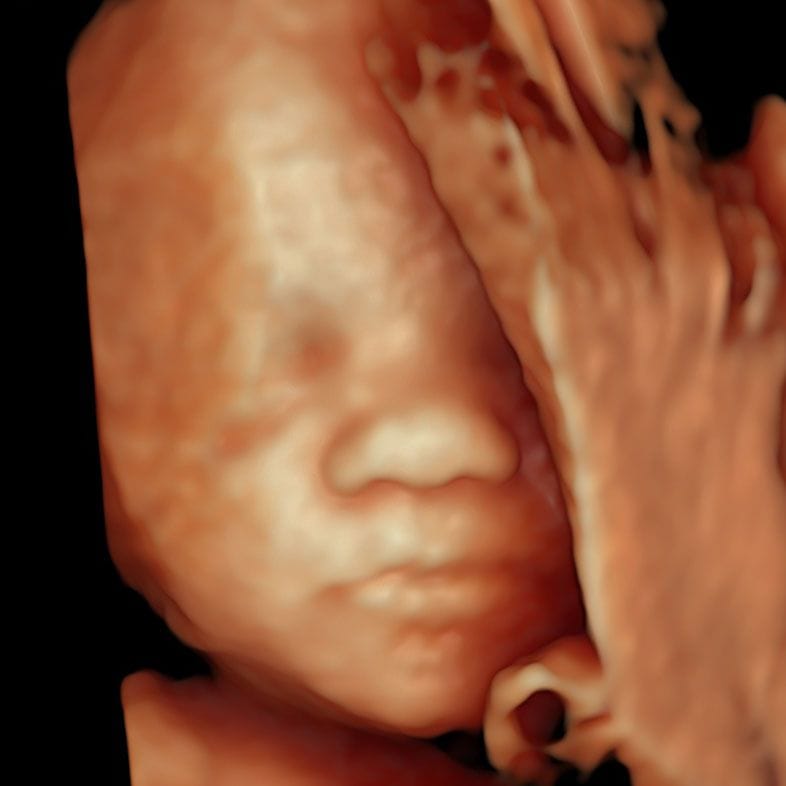
The 3rd Trimester is key in your baby’s development
The NHS fetal screening program in the UK does not include any additional scans after the 18-20 weeks anomaly scan for pregnant women with no risk factors. This means that for the majority of women, the 18-20 weeks scan is the last scan in their pregnancy. However, in many other countries, there are additional ultrasound scans schedules for the third trimester, which aim to evaluate fetal growth and development.
According to a 2020 study across two UK centres — King’s College Hospital, London and Medway Maritime Hospital, Gillingham, Kent — around a quarter (24.8%) of all fetal anomalies were first detected in the third trimester (Ficara et al., 2020). The study found that the main organs affected by late manifesting anomalies were the brain, the heart, and the kidneys.
Why the third trimester is key in your baby’s development
The fetal brain develops throughout all stages of pregnancy and continue developing even after birth. Unfortunately, some severe brain anomalies can have delayed development or manifestation, thus not be picked up by some of the anomaly scans performed at around 20 weeks. Late manifesting anomalies can also affect the heart, some of which include diseases of heart valves, tumours, and heart rhythm abnormalities.
Our 3rd Trimester Anomaly Scan aims to exclude some fetal anomalies which have a late presentation, and also control fetal growth and wellbeing. The reason of doing this scan at 26-29 weeks is that from around 30 weeks is technically impossible to perform complete check up of the baby.
The Benefits of Our 3rd trimester Scan
The scan combines the Late Anomaly Scan and an examination of Fetal Wellbeing
During the 3rd Trimester Anomaly Scan, we perform a well-being scan together with a thorough examination of the fetus (like at our Anomaly Scan), and placenta. amniotic fluid, and the womb.
The full details of the 3rd Trimester Anomaly Scan include:
- Advanced examination of the heart with colour Doppler flow imaging (looking at how the blood flows through the heart),
- An examination of the brain, kidneys, and the stomach,
- An examination of other fetal structures visible by this stage (can be dependent on fetal position),
- A fetal growth scan,
- A fetal wellbeing examination (fetal movements, amniotic fluid, and fetal Dopplers used to detect the fetal heartbeat),
- Examination of the placenta.

What we check
Late-onset anomaly checks
Plan your next step
You have a question? We have an answer.
What is the difference between our 3rd Trimester Anomaly Scan and Growth Scan available elsewhere?
As the name suggests, the primary purpose of the Growth Scan is to measure the dimensions of the baby, without looking at its anatomy or structural development. Thus, the anomalies undiagnosed in the earlier scans (for various reasons) can be yet again missed by the Growth Scan.
On the other hand, the 3rd Trimester Anomaly Scan aims to check structural and developmental aspects of the baby as well as its in-utero environment.
Can the combination of all the scans mentioned exclude all anomalies and problems?
No, unfortunately it is impossible to diagnose all anomalies before birth. The most common unrecognised anomalies are isolated cleft palate (a split in the roof of the mouth where the lips are intact) and abnormalities of the external genitalia (ambiguous genitalia).
Some rare genetic conditions are also not detectable by any ultrasound scans.
What is the difference between 3D and 4D ultrasound?
We all know what a 3D image image is, but what is the 4th dimension? 4D is just a fancy way of referring to a moving 3D images which allows us to view the baby in 3D from different angles and to see baby’s own movements. This is an advanced ultrasound technology and requires expertise from the clinician and well as special ultrasound probes.
Is it possible to perform a 3D/4D scan during Fetal Development Scan?
Yes, we try to get good quality 3D/4D images of your baby during this scan. We are aware that many parents enjoy seeing these images of their baby and we are happy to accommodate this. Having said that, in some instances if the baby is not positioned correctly or we are unable to get a good quality image, we will not push or disturb your baby just for the image.
Please remember that the primary aim of the 3rd Trimester Anomaly Scan is to check the health and development of your baby, not for keepsake images, although we will try to capture these as well, where possible. We do not offer 3d/4d scans as baby bonding scans.
Can I have my images from the scan? What else will I get?
Yes, of course. We use Tricefy which is a secure cloud system to upload images from your scan to be viewed before you even leave the scanning room! You will also receive a hard and soft copy of your detailed ultrasound report as well as some high-quality colour printouts for you to take home with you!
Tricefy also allows you to download the images from the scan and share him with your loved ones via message/social media.
We provide still ultrasound images for you to take away with you on the day. We also send these to you electronically, with a couple of video clips. We provide a USB stick with the full 3D/4D experience.
Contact
Do you want to know more about our third trimester anomaly scan?
Sources & clinical references
The figures and clinical statements on this page are drawn from the sources below. Guidance evolves — always discuss your individual circumstances with a clinician.
- National Institute for Health and Care Excellence (NICE)Antenatal care (NG201): recommendations on ultrasound scans in pregnancy2021
- NHS England / GOV.UKNHS Fetal Anomaly Screening Programme (FASP): programme overview2025
- NHS20-week screening scan2025
- International Society of Ultrasound in Obstetrics and Gynecology (ISUOG)ISUOG Practice Guidelines: performance of third-trimester obstetric ultrasound scan2024
- Ultrasound in Obstetrics & Gynecology (via PubMed Central)Routine 36-week scan: diagnosis of fetal abnormalities2025