
Arrival and a few questions
You will be welcomed and asked briefly about how your pregnancy has been going. There is no need to arrive with a full bladder for a third-trimester scan.
This special 3rd trimester scan can be performed to exclude late pregnancy anomalies and check the baby’s growth and wellbeing. If technically feasible, a 3D/4D scan will be included.
Available atLPC City (E1)LPC West (SW10)
The NHS fetal screening program in the UK does not include any additional scans after the 18-20 weeks anomaly scan for pregnant women with no risk factors. This means that for the majority of women, the 18-20 weeks scan is the last pregnancy scan. However, in many other countries, there are additional third trimester ultrasound scans which include an evaluation of fetal growth and development.
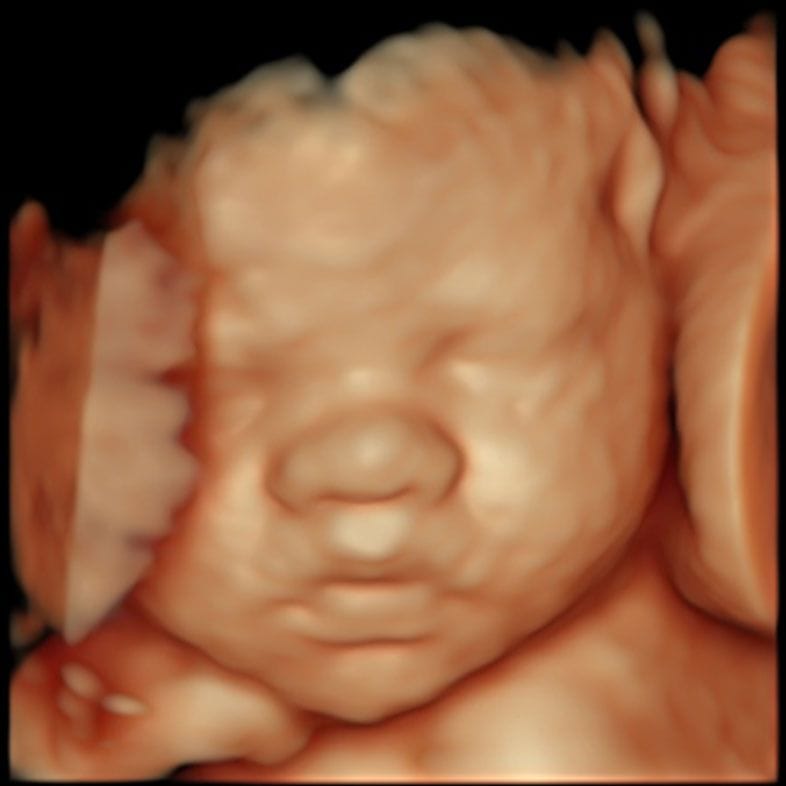
The vast majority of pregnancies reach the third trimester without any problems, and most babies are growing exactly as expected. Late changes in growth, fluid or the placenta are uncommon and cannot always be predicted from earlier scans, which is why some parents choose an extra check after 30 weeks — for monitoring and reassurance alongside, never instead of, your routine NHS care.
During the wellbeing scan we perform a thorough examination of the fetus, placenta position, amniotic fluid, and the womb.
This scan is very similar to our 3rd trimester anomaly scan at 26-29 weeks, however beyond 30 weeks it is impossible to perform a complete check-up of fetal anatomy. The baby is big, and the scan is dependent on fetal position. Some babies will hide their faces, others will cover their heart with both arms. In any case we will put in the maximum possible effort to check your baby’s structures. Fetal position will not affect its wellbeing examination.
The full details of the fetal wellbeing scan include:
According to a 2020 study across two UK centres — King’s College Hospital, London and Medway Maritime Hospital, Gillingham, Kent — around a quarter (24.8%) of all fetal anomalies were detected for the first time at the routine 35–37 week scan (Ficara et al., 2020). The study found that the main organs affected by late manifesting anomalies were the brain, the heart, and the kidneys.
The fetal brain develops throughout all stages of pregnancy and continues developing even after birth. Unfortunately, some severe brain anomalies can have delayed development or manifestation, thus not being picked up by some of the anomaly scans performed earlier in the pregnancy and even at the 3rd trimester anomaly scan at 26-29 weeks.
At our wellbeing scans, we are trying to exclude late developmental events affecting the fetal brain like progressive development of ventriculomegaly or unfortunate events of bleeding into the brain. We will perform maximal effort to confirm normal development of the brain, however, understandably ultrasound cannot exclude all cases of brain anomalies or disabilities.
This scan suits anyone who would like a detailed check of their baby's growth, movements and surroundings in the final weeks of pregnancy. Many parents book one purely for reassurance after the 18–20 week anomaly scan — usually the final routine NHS scan, as explained above.
Others come because a previous pregnancy involved growth concerns, or because they would simply like to know their baby is growing steadily and settling head-down before the birth. The growth measurements we take are the same ones clinicians use to identify babies measuring small for their stage of pregnancy, so anything that needs a closer look can be shared with your NHS team early. The appointment can also follow naturally from a growth scan or a third trimester anomaly scan.
It is designed to complement, not replace, your NHS antenatal care — your midwife remains your first point of contact for any urgent concern between appointments.
You will be welcomed and asked briefly about how your pregnancy has been going. There is no need to arrive with a full bladder for a third-trimester scan.
You lie back comfortably while a little warm gel is applied to your bump and the sonographer moves the probe gently across it. The scan is painless, and you can watch your baby on the screen throughout.
Your baby's measurements are taken and plotted on growth charts to estimate weight and check the pattern of growth. The full list of what we look at is summarised in the checks below.
If your baby is in a helpful position and conditions allow, we will try to capture 3D/4D images for you. This is never guaranteed late in pregnancy, as it depends on your baby's position and the space around them.
A specialist fetal medicine clinician reviews the findings and explains what they mean. You leave with a written report and your images, and we advise whether any follow-up or onward referral would be helpful.
What we check
Most wellbeing scans are reassuring, showing a baby who is growing well, moving normally and surrounded by a healthy volume of amniotic fluid. If a measurement sits outside the expected range, or the fluid or blood flow looks different from usual, our specialist fetal medicine clinicians will explain the finding clearly and, where helpful, arrange a repeat scan or refer you back to your NHS maternity team. Please remember that no scan can guarantee a healthy outcome, and this information is for general education rather than medical advice — if you notice any change in your baby's movements, or have any other concern, contact your midwife or maternity unit straight away rather than waiting for an appointment. Many parents pair this scan with a later presentation scan in the weeks before birth.
What the NHS offers as standard is the 18–20 week anomaly scan, and for women with no risk factors this is usually the last routine scan of the pregnancy. Unlike many other countries, the NHS fetal screening programme does not include a routine third-trimester scan of growth and wellbeing, so most women are not offered further imaging after the 20-week check.
Some NHS Trusts in London do have local protocols for a routine third-trimester growth scan, so it is worth asking your midwife whether this applies at your hospital. If it does not, or if you would simply like extra reassurance later in pregnancy, our wellbeing scan offers a detailed look at your baby’s growth, movements, fluid, placenta, and Doppler blood flow beyond 30 weeks.
Yes, of course. We use Tricefy which is a secure cloud system to upload images and videos from your scan to be viewed before you even leave the scanning room! You will also receive a hard and soft copy of your detailed ultrasound scan, including some high-quality colour printouts for you to take home with you!
Tricefy also allows you to download the images and videos from the scan to share with your loved ones via message/social media.
Advice on the COVID-19 vaccine has changed since the pandemic. Pregnancy on its own no longer makes you eligible for an NHS COVID-19 vaccine: the NHS now offers it to people aged 75 and over, residents of care homes for older adults and anyone with a weakened immune system. If you are in one of those groups, you can still have it while pregnant or breastfeeding, so it is best to check your eligibility with your GP or midwife.
The vaccines every pregnant woman is offered free on the NHS are the flu jab (in flu season, at any stage of pregnancy), whooping cough (from 16 weeks, ideally before 32 weeks) and RSV (from 28 weeks). Our vaccines in pregnancy guide explains the timing of each.
This guidance can be updated over time, so your midwife or GP remains the best source for advice tailored to you and your pregnancy. The wellbeing scan itself is unaffected by whether you have been vaccinated; it focuses on your baby’s growth, movements, and blood flow in the third trimester, and you are welcome to raise any concerns with our clinicians on the day.
Contact us now if you’ve been searching for a “wellbeing scan near me”.
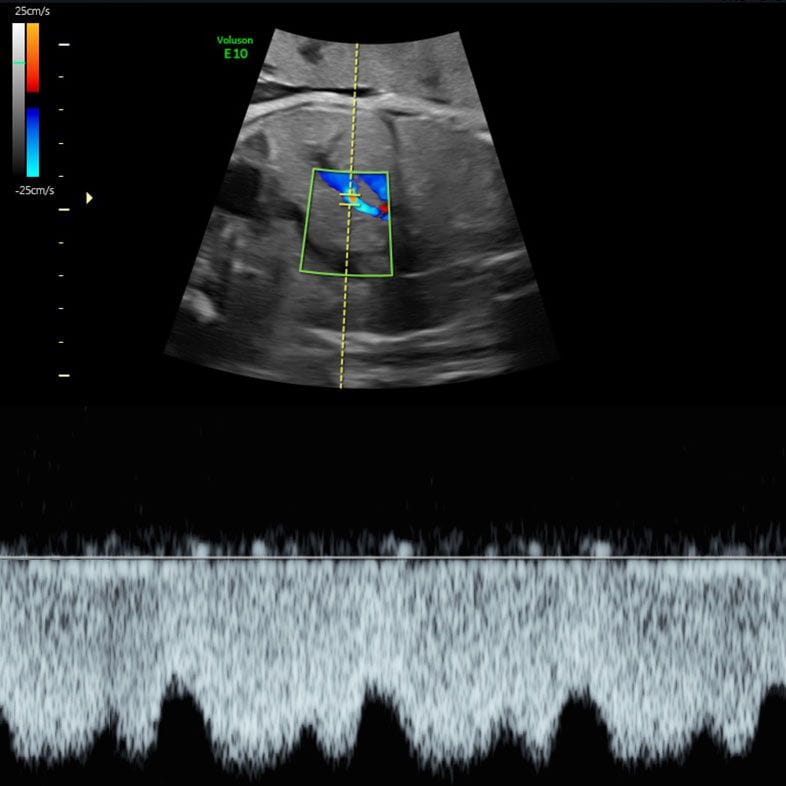
A wellbeing scan is a detailed third-trimester ultrasound that checks how your baby is growing and coping in the final weeks before birth. It assesses estimated fetal weight, movements, the volume of amniotic fluid, the position and health of the placenta, and blood flow to your baby using Doppler.
Where your baby's position allows, we will also try to include 3D/4D images. To see how this appointment sits alongside the rest of our care, browse our full range of pregnancy scans.
This scan is generally carried out from around 30 weeks onwards. At our clinic the usual window is 30 to 35 weeks, which allows a thorough look at growth and wellbeing while there is still time to plan should anything need closer monitoring.
Slightly earlier, a third trimester anomaly scan at 26–29 weeks allows a more complete check of your baby's anatomy, because the baby is smaller and easier to see in full.
The two overlap and the terms are often used together. A growth scan focuses mainly on measuring your baby and plotting the estimated weight on growth charts to check the pattern of growth over time.
A wellbeing scan includes those growth measurements but also looks more broadly at your baby's condition — movements, amniotic fluid, the placenta and Doppler blood flow — giving a fuller picture of both size and wellbeing late in pregnancy.
Yes. Ultrasound uses sound waves rather than radiation and has been used in pregnancy for decades; the NHS advises there are no known risks to you or your baby from having an ultrasound scan.
The appointment is painless and non-invasive. Between scans, if you notice any change in your baby's movements, NHS guidance is to call your midwife or maternity unit straight away rather than waiting.
Our wellbeing scan costs £260. The fee covers the full third-trimester examination — growth measurements, amniotic fluid, placenta and Doppler blood flow — with 3D/4D images included where your baby's position allows.
You also receive a written report reviewed by a specialist fetal medicine clinician, plus digital copies of your images and videos through our secure Tricefy system. You can book a wellbeing scan online or call the clinic.
Amniotic fluid is measured at every growth scan. A result outside the expected range is common and often means more monitoring rather than a problem.
We explain both in full: polyhydramnios when there is more fluid than expected, and oligohydramnios when there is less. If you have had a sudden gush of fluid or your baby is moving less, contact your maternity unit the same day rather than waiting for a scan.
By 30–35 weeks, most women will have been offered three NHS vaccines: whooping cough (from 16 weeks, ideally before 32), RSV (from 28 weeks) and — if any part of your pregnancy falls in flu season — the flu jab, which is safe at any stage. All three are free on the NHS.
If you have missed one, it is usually still worth catching up. Our whooping cough, RSV and flu vaccine guides explain the timing and the evidence behind each.
Contact
The figures and clinical statements on this page are drawn from the sources below. Guidance evolves — always discuss your individual circumstances with a clinician.
Cookies on this site
We use cookies needed to run this site. With your permission we would also use analytics and advertising cookies to see how the site is used and which of our adverts lead to bookings. Declining will not affect your care or your booking. See our Privacy notice and Terms & Conditions.