
Genetic Blood Testing When a Miscarriage Has Been Diagnosed

When a miscarriage has been diagnosed but the pregnancy is still in the womb, the placenta keeps releasing tiny fragments of its DNA into your blood. A blood sample, taken straight after a confirming scan, can be checked for extra or missing chromosomes without any pregnancy tissue.

It is not a definitive test. It finds most but not all chromosome changes, some samples give no result, and it is not part of standard NHS care. Our genetic counsellors can help you weigh it up, ideally before any tablets or surgery.

The science

Where the DNA in your blood sample comes from

Your blood always carries small, free-floating pieces of DNA, known as cell-free DNA. In pregnancy, some of them come from the placenta. After a miscarriage this placental share, which laboratories call the fetal fraction, is typically only around 5 in every 100 fragments.

The laboratory reads a very large number of fragments and works out which chromosome each came from. An extra copy of a chromosome in the placenta means slightly more fragments map to it than expected; a missing copy means slightly fewer. Because the placental share is small, these differences are subtle, so the amount of placental DNA matters a great deal.

The placenta and the pregnancy grow from the same fertilised egg, so their chromosomes are usually, though not always, identical. Until a pregnancy that has stopped developing passes naturally or is treated, its placenta keeps releasing DNA. Once the tissue has passed or been removed, placental DNA in your blood declines over the following hours and days.

NIPT and miscarriage

The same science as NIPT, asked a different question

If you have heard of NIPT (non-invasive prenatal testing), the principle will sound familiar. The differences are important.

Screening

NIPT in a continuing pregnancy

Screens an ongoing pregnancy, usually from around 10 weeks. On the NHS it follows a higher-chance screening result and looks only for Down's, Edwards' and Patau's syndromes. Our NIPT guide covers the wider private options.
Explaining a loss

Blood testing after a miscarriage diagnosis

The tests studied look at every chromosome, because the trisomies most often behind miscarriage, such as trisomy 16 and 22, sit outside NHS screening. Studies have used it from around 5 weeks of pregnancy.

Thresholds

Why laboratory settings matter

In one study, thresholds adjusted for pregnancy loss detected about 82 in 100 chromosome changes; standard prenatal settings detected about 55 in 100 on the same samples.

Step by step

How testing usually works, from diagnosis to result

1

The miscarriage is confirmed

By scan, following the NICE criteria. The blood test cannot diagnose a miscarriage and is only considered once the diagnosis is certain.

2

You talk it through

A genetic counsellor explains what the test can and cannot show, and how it fits around the way you plan to manage the miscarriage.

3

A scan just before the sample

This checks the pregnancy is in the womb, tissue is still present and there is only one sac.

4

A routine blood sample

Taken from your arm like any other blood test, ideally before any miscarriage medicine or surgery.

5

Laboratory analysis

The lab measures the placental DNA, then counts fragments from every chromosome. If there is too little to read reliably, it reports no result rather than guessing.

6

Results and next steps

Given with time to talk: what was found, how confident the result is, and whether further tests or a genetics referral would help.

The scan

What the scan on the day of sampling checks

No guideline yet sets out exactly how this test should be done. The research studies included only women whose scan had confirmed a pregnancy in the womb, and most took blood while pregnancy tissue was still in place. A scan immediately before the blood sample follows the same logic and makes the result easier to interpret.

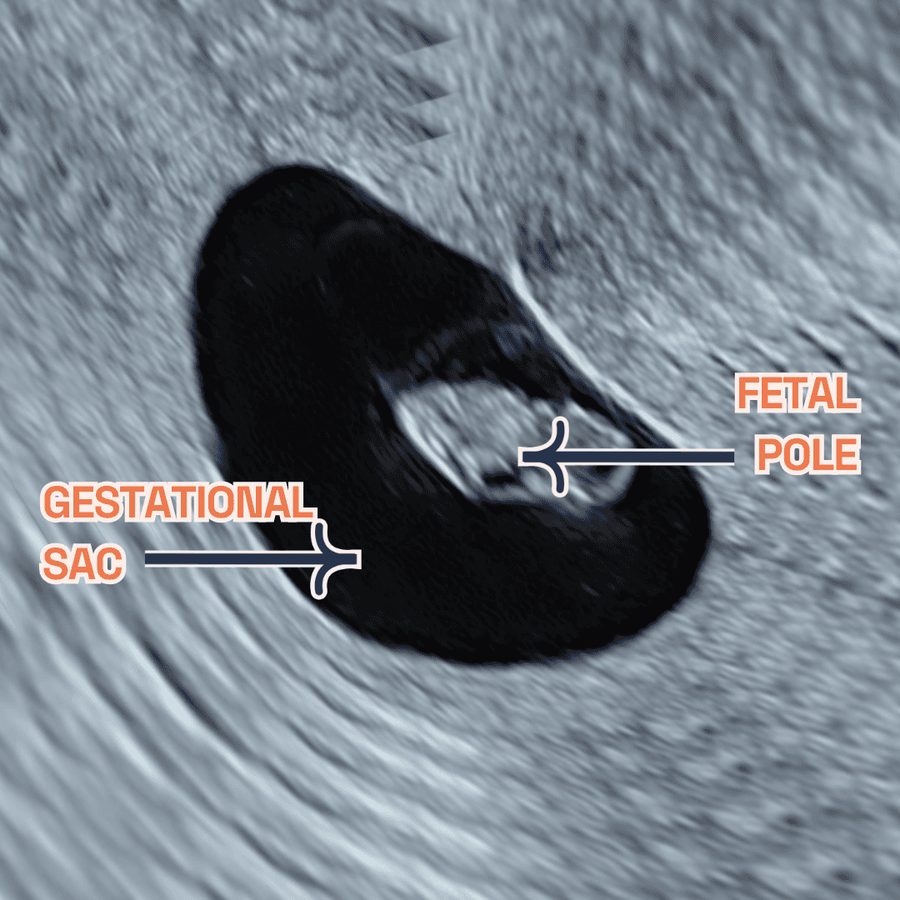
The scan looks at four things: that the pregnancy is in the womb rather than in a tube or an unknown location (see ectopic pregnancy); that placental tissue is still there; that there is no second sac, a sign of a 'vanished twin' that could confuse the result; and that there are no features of a molar pregnancy, which the studies excluded.

If there is any doubt that the pregnancy has stopped developing, the right next step is another scan, not a genetic test. NICE describes when a second opinion or a repeat scan is needed before a miscarriage is confirmed, and you can book a second-opinion scan with us for an independent look.

Early pregnancy ultrasound image with labels pointing to the gestational sac and to the fetal pole inside it
A scan just before sampling confirms that pregnancy tissue is still in the womb

Timing

How timing changes the chance of a result

Placental DNA does not vanish the moment a miscarriage passes, but it does fall. A Danish study of 1,463 women recorded how often samples taken at different times gave no clear answer (El Sammaa-Aru et al., 2026).

When the blood sample was takenPlacental DNA in the bloodSamples with no clear result
Tissue still in the wombAt its highestAbout 9 in 100
12 to 24 hours after the tissue passedLower: a median fetal fraction of 2.8% beyond 12 hours, against 4.7% within 6 hoursAbout 27 in 100
About 3 days after surgical removalStill measurable in some womenAbout 30 in 100

One research cohort and one laboratory method; others may differ. The 3-day figure comes from a small group sampled again after surgery. In the same cohort, higher levels of the pregnancy hormone hCG were linked with a better chance of a conclusive result.

Accuracy

How well does it work? The main studies

Each figure compares blood results with genetic testing of tissue from the same pregnancy, and describes groups of women rather than any one person.

78% Of chromosome changes found in tissue were also picked up by the blood test, pooling 8 studies of 552 miscarriages (Pauta et al., 2025)
91% Of miscarriages with normal chromosomes were correctly reported as normal in that analysis, so about 9 in 100 were wrongly flagged
85% Detection in the largest study (COPL, Denmark; Lancet 2023), checked against tissue in its first 333 women; 11 in 100 of its 1,000 tests gave no clear result
82% vs 55% Detection with thresholds adjusted for pregnancy loss, compared with standard prenatal-screening settings (Yaron et al., 2020)
59% Of chromosome changes found in tissue were identified in a small UK study of 57 miscarriages at Tommy's National Centre for Miscarriage Research (Colley et al., 2020)

Making sense of the numbers

What these percentages mean for your result

In plain terms, the blood test finds nearly four in every five chromosome changes that tissue testing would find. An abnormal result is usually right: in the pooled analysis, where about 6 in 10 miscarriages had a chromosome change, an abnormal blood result meant about a 93 in 100 chance that tissue testing would show one. A normal result is weaker reassurance, because the chance of a chromosome change was still about 28 in 100.

If no tissue was kept, a blood result usually cannot be checked against anything else. Researchers therefore describe it as a screening test whose results cannot be definitively confirmed, and we explain results on that basis rather than as certainties.

Reports with no result averaged about 4 in 100 across the pooled studies, though one early study had more than 1 in 4, mostly in losses before 8 weeks. A no-result report usually means there was not enough placental DNA to read.

Scope

Which chromosome changes it can and cannot detect

Laboratories differ, so ask what a specific test reports. Our guide to chromosomal causes of miscarriage explains each type of change.

Type of changeBlood testWhat to know
Extra or missing whole chromosome (trisomy, monosomy)Usually detectedThe commonest findings in miscarriage, led by trisomy 16, then 22 and 21.
Monosomy X (one X instead of two)Detected, with cautionMay reflect the placenta alone, or some of the mother's own cells with one X, which become more common with age.
Triploidy (an extra full set of chromosomes)Not detected by counting methodsIncluding triploid cases would cut pooled detection from 78% to 72%. Some SNP-based tests find certain types in ongoing pregnancies; unproven after miscarriage.
Large missing or extra piecesSometimesIn one UK study, only 2 of 6 large imbalances seen in tissue were picked up.
Small deletions and duplicationsUsually notBelow the resolution of most blood-based methods; a tissue microarray sees far smaller changes.
Balanced rearrangementsNoNothing is missing or extra, so there is nothing to count.
Mosaicism (mixed normal and abnormal cells)Often missedLow-level mosaicism may not show; placenta-only changes can mislead.
Uniparental disomy, single-gene conditionsNoThese need different kinds of genetic test.

Unexpected results

Why a blood result can differ from the pregnancy

Occasionally the blood result and the pregnancy's own chromosomes do not match. An unexpected result should always be reviewed by a genetics professional.

  • Placenta-only changes: the placenta can carry a chromosome change that is absent from the pregnancy, or the reverse (confined placental mosaicism).
  • A vanished twin: DNA from a second pregnancy that stopped earlier can remain in the blood.
  • Your own DNA: a low level of your own cells with a chromosome change, such as cells with only one X, can appear in the analysis.
  • Very rarely, your own health: as with NIPT in ongoing pregnancies, an unusual pattern can occasionally point to a condition in the mother. A specialist would explain any follow-up.
  • Too little placental DNA: a low fetal fraction can hide a chromosome change completely.

Why consider it

What a blood-based test can offer

No pregnancy tissue needed

A result does not depend on collecting, storing or transporting tissue.

Done before treatment begins

The sample is taken before tablets or surgery, so it need not hold up the care you have chosen.

Still possible if the miscarriage passes at home

The sample is already taken, so tissue that passes at home and cannot be collected does not matter. In one large study, about 1 in 3 women could not provide usable tissue.

A backup if tissue testing fails

If tissue turns out to contain only the mother's cells, an earlier blood result may still give an answer.

Choosing a test

When testing the pregnancy tissue is the better option

Testing the pregnancy tissue is the reference standard that blood results are judged against, and where good tissue is likely to be available it usually gives a fuller answer. It is the stronger choice in these situations.

A suspected molar pregnancythe blood test was not studied here, and the tissue itself needs examining.
Small or structural changesa microarray on tissue finds small missing or extra pieces that blood testing misses.
A miscarriage from 14 weekstissue testing is usually offered on the NHS.
Recurrent miscarriagefrom the third loss, NHS tissue testing includes a whole-genome microarray, and an unbalanced rearrangement can lead to chromosome tests for both parents.
The miscarriage has already passedplacental DNA falls after about 12 hours and more blood tests give no result, so any tissue that was kept is usually the better route.

See our guides to pregnancy tissue testing and choosing between a blood test and a tissue test.

Before you decide

Questions worth asking about any blood-based test

Tests offered after miscarriage vary. A genetic counsellor can help you get clear answers to these questions.

Does it look at every chromosome, and has it been validated in miscarriage rather than only in ongoing pregnancies?

Does the laboratory use thresholds designed for pregnancy loss?

What will it not detect, such as triploidy or small deletions?

How often does it give no result, and what happens then?

Is a scan needed immediately before the sample, and who arranges it?

How long do results take, and who explains them, especially if they are unexpected?

Your options in the UK

NHS care, current research and how we can help

Your NHS early pregnancy unit confirms and manages miscarriage free of charge, and that care comes first. NHS genetic testing after miscarriage uses pregnancy tissue, usually from the third miscarriage, after a loss from 14 weeks, or sooner if there are features suggesting a chromosome condition.

Blood-based testing after miscarriage is not yet part of standard NHS care, and UK researchers, some funded by Tommy's, are still assessing how it should be used.

If you are considering it, start with a conversation. Our genetic counsellors can discuss by video whether it suits your circumstances and how it compares with tissue testing. The useful window is short, so please call 020 3687 2939 early.

How we can help

Talk it through with our team

Genetic counselling takes place online by video; our scanning clinics are in the City and West London.

Blood-based miscarriage testing: your questions

Is this the same blood test as the NIPT offered during pregnancy?

The principle is the same, reading placental DNA in your blood, but the set-up differs. The tests studied after miscarriage look at every chromosome and performed better with thresholds adjusted for pregnancy loss. A standard NIPT ordered for an ongoing pregnancy is not designed for this; in one study, standard settings found only about half of the chromosome changes.

Does it work after a very early miscarriage?

It can. Studies have included losses from around 5 weeks, although one early study had more failed tests before 8 weeks, and a UK study found results were more often correct later in pregnancy. A key factor is how much placental DNA is in your blood, which tends to be higher when the pregnancy hormone hCG is higher.

Could an earlier twin pregnancy affect the result?

Yes. DNA from a twin that stopped developing earlier, sometimes called a vanished twin, can linger in the blood and mix with DNA from the pregnancy being tested. If a second sac was seen at any stage, tell your genetic counsellor before the test.

If the blood test finds a trisomy, should we both have our chromosomes checked?

Usually not. Most trisomies arise by chance as an egg or sperm forms, and the parents' chromosomes are normal. UK guidance on recurrent miscarriage reserves parental testing mainly for when tissue shows an unbalanced rearrangement or no tissue result could be obtained. Rarely, a trisomy is linked to a rearrangement in a parent, so go through the result with a genetics professional.

Is an abnormal blood result proof of why I miscarried?

It is strong evidence rather than proof. In pooled research, an abnormal blood result meant about a 93 in 100 chance that tissue testing would show a chromosome change. Because it reflects the placenta and usually cannot be checked afterwards, it counts as a screening-type result. Research suggests a loss caused by a chromosome change is linked with a better chance of success next time than a loss with normal chromosomes.

What happens if the test gives no result?

Usually there was too little placental DNA. If the tissue is still in the womb, ask whether a second sample is possible; if not, tissue testing may still be an option if tissue can be collected. Ask how a no-result report is handled before you have the test.

Looking after yourself

Deciding about testing while coming to terms with a miscarriage is a lot to carry. There is no right or wrong choice, and deciding not to test is entirely reasonable. Our miscarriage support page lists charities and helplines.

About this information

This page explains, in general terms, how blood-based genetic testing works once a miscarriage has been diagnosed. It is not personal medical advice and cannot replace the clinicians who know your scans and history. If you have heavy bleeding, severe pain, a fever or feel faint, contact your early pregnancy unit or call NHS 111 straight away, or 999 in an emergency.

Contact

Questions about a genetic blood test?

Send us an enquiry

This form is not for emergencies. If you are bleeding heavily, in severe pain or feel faint, call 999 or go to A&E.

For urgent matters please call 020 3687 2939.

Sources & clinical references

The figures and clinical statements on this page are drawn from the sources below. Guidance evolves — always discuss your individual circumstances with a clinician.

  1. Prenatal Diagnosis (Pauta et al.)Genome-wide cell-free DNA analysis for aneuploidy detection in miscarriages: test performance meta-analysis2025
  2. The Lancet (Schlaikjaer Hartwig et al.)Cell-free fetal DNA for genetic evaluation in Copenhagen Pregnancy Loss Study (COPL): a prospective cohort study2023
  3. Human Reproduction (El Sammaa-Aru et al.)How big is the time window for cell-free fetal DNA testing after pregnancy loss and which factors are associated with a successful result?2026
  4. Human Reproduction (Yaron et al.)Maternal plasma genome-wide cell-free DNA can detect fetal aneuploidy in early and recurrent pregnancy loss2020
  5. Journal of Clinical Medicine (Colley et al.)Cell-free DNA in the investigation of miscarriage2020
  6. Fetal Diagnosis and Therapy (Nicolaides et al.)Prenatal detection of fetal triploidy from cell-free DNA testing in maternal blood2014
  7. Scientific Reports (Xue et al.)Genetic analysis of chorionic villus tissues in early missed abortions2023
  8. Tommy'sUsing fetal DNA to detect chromosomal abnormalities following miscarriageAccessed October 2026
  9. RCOGRecurrent Miscarriage (Green-top Guideline No. 17)2023
  10. NHS EnglandNational Genomic Test Directory: testing criteria for rare and inherited disease (version 9.1)2026
  11. NICEEctopic pregnancy and miscarriage (NG126): diagnosis of viable intrauterine pregnancy and of tubal ectopic pregnancy2026
  12. GOV.UK (NHS screening programmes)Screening tests for you and your baby: Down's syndrome, Edwards' syndrome and Patau's syndrome2026