
Functional
Follicular cyst
Each month a follicle grows on the ovary to release an egg. If it does not release the egg and keeps growing, it can form a follicular cyst. These usually shrink over the next few cycles without treatment.
An ovarian cyst is a fluid-filled sac on an ovary. Most are harmless and disappear on their own within a few months, but a clear scan is what tells a simple, self-resolving cyst apart from one that needs follow-up. Our ovarian cyst scan is a detailed pelvic ultrasound, usually transvaginal, with a written report and your images.
Choose a pelvic scan with a specialist gynaecology sonographer at LPC | City or LPC | West, or a consultant gynaecologist consultation and scan in one visit at LPC | City.
Available atLPC City (E1)LPC West (SW10)
A cyst that twists the ovary (torsion) or bursts (rupture) can cause sudden, severe pelvic pain, often with nausea or vomiting. The NHS advises calling 999 or going to A&E if pelvic pain is severe, getting worse, or hurts when you move or touch the area, or if you feel faint, dizzy or lightheaded, or pass out. For other sudden pelvic pain, or tummy pain while feeling or being sick, ask for an urgent GP appointment or contact NHS 111. If there is any chance you could be pregnant, sharp, sudden, intense tummy pain with dizziness, fainting or looking very pale can be a sign of an ectopic pregnancy: call 999 or go to A&E.
An ovarian cyst is a fluid-filled sac that develops on or in an ovary. Cysts are very common before the menopause, and most are linked to the normal menstrual cycle. According to the NHS, the vast majority are non-cancerous (benign), although cancerous cysts are more common after the menopause.
Before the menopause, the Royal College of Obstetricians and Gynaecologists (RCOG) notes that almost all ovarian masses and cysts are benign. It puts the chance of a symptomatic cyst being cancerous at about 1 in 1,000, rising to about 3 in 1,000 at the age of 50.
Many cysts are found by chance, on a scan done for another reason. The finding itself is rarely the whole story: what matters is what the cyst looks like, its size, whether you have been through the menopause, and whether it changes over time. That is what a detailed scan, and the guidance built around it, is designed to answer.
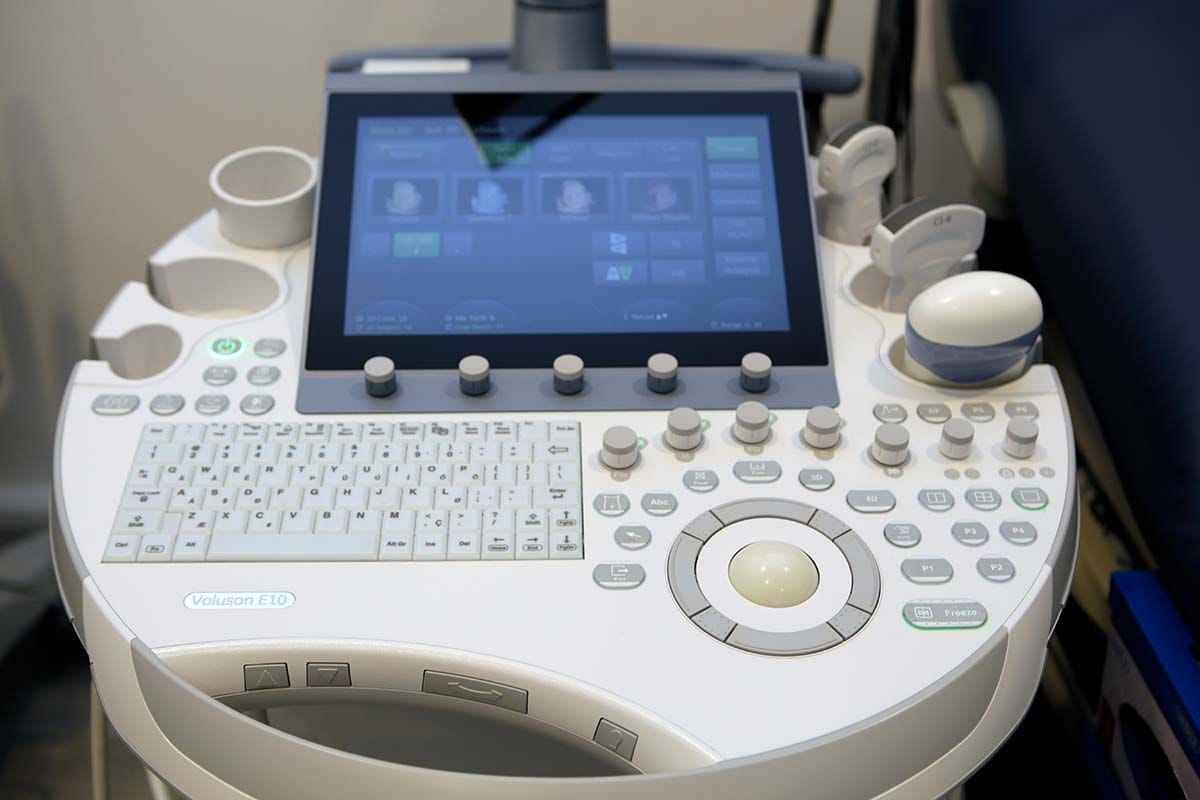
If you have symptoms, or a cyst has already been found, your GP can refer you for a pelvic ultrasound on the NHS, and NHS gynaecology teams follow up cysts that need monitoring at no cost to you. Waiting times vary. We offer the same kind of scan privately for people who want it sooner, at a time that suits them, or as a second look. If you are already under NHS follow-up, it is worth letting your team know about any private scan you have.
Cysts fall into two broad groups. Functional cysts form as part of the menstrual cycle and are by far the most common. Other (pathological) cysts come from abnormal cell growth; they are usually benign too, but they are not expected to go away on their own.
Functional
Each month a follicle grows on the ovary to release an egg. If it does not release the egg and keeps growing, it can form a follicular cyst. These usually shrink over the next few cycles without treatment.
Functional
After ovulation, the empty follicle becomes the corpus luteum, which makes the hormone progesterone. Sometimes it fills with fluid and forms a cyst. These are usually harmless and settle on their own, including in early pregnancy.
Endometriosis
A blood-filled cyst caused by endometriosis, where tissue similar to the womb lining grows on the ovary. It is usually assessed and managed as part of endometriosis care, rather than expected to resolve like a functional cyst.
Pathological
A benign cyst that can contain cells like those found in hair, skin or teeth. The RCOG notes that dermoid cysts can grow over time, raising the chance of pain or twisting, so surgery is usually considered.
Pathological
A benign cyst that forms on the surface of the ovary and is filled with watery (serous) or thicker, mucus-like (mucinous) fluid. Unlike functional cysts, cystadenomas are not expected to shrink away on their own.
Not the same thing
The many small 'cysts' seen in polycystic ovary syndrome are egg follicles that have not matured to ovulation. PCOS is a hormonal condition, not a single ovarian cyst.
Most ovarian cysts cause no symptoms at all. The NHS explains that a cyst usually only causes symptoms if it splits (ruptures), is very large, or twists and blocks the blood supply to the ovary.
When a cyst does cause symptoms, they can include:
These symptoms are common and have many possible causes, most of them not serious. But a swollen or bloated tummy, feeling full quickly, tummy or pelvic pain and needing to pee more often can also be symptoms of ovarian cancer. The NHS advises seeing a GP if you have these symptoms, especially if they happen often (around 12 or more times a month), or if they have not gone away after an earlier GP visit. Our page on ovarian cancer screening explains the symptoms and the role of CA125 testing.
Ultrasound is the main test for an ovarian cyst. RCOG guidance describes pelvic ultrasound as the single most effective way to evaluate one, with transvaginal ultrasound preferred because it is more sensitive than a scan through the tummy (transabdominal); for women after the menopause, the RCOG names transvaginal ultrasound itself as the single most effective test. A tummy scan is sometimes added for a large cyst that extends beyond the transvaginal view.
A detailed scan describes the cyst so that it can be classified. This typically covers:
Specialists use standardised frameworks to turn these features into a level of concern. The International Ovarian Tumour Analysis (IOTA) group's simple rules use five features that suggest a benign cyst and five that suggest a cancerous one.
In a study of 1,938 women across 19 centres, the rules gave a clear answer for 77 per cent of masses, with a sensitivity of 92 per cent and specificity of 96 per cent; the remainder needed assessment by an experienced specialist.
The O-RADS system, developed by an international committee sponsored by the American College of Radiology and built partly on IOTA data, sorts findings into six categories (O-RADS 0 to 5), ranging from normal to high risk of cancer, each with a suggested next step.
After the menopause, and whenever a cyst looks complex, a blood test called CA125 is usually added. It feeds into the Risk of Malignancy Index (RMI), which combines the ultrasound score, menopausal status and CA125 level. RCOG guidance uses an RMI of 200 or more, and NICE a score of 250 or more, as the point at which care passes to a specialist gynaecological oncology team. Before the menopause, the RCOG says CA125 is not needed when a scan clearly shows a simple cyst, because it is often raised by non-cancerous conditions such as endometriosis, fibroids or pelvic infection.
Follow-up depends mainly on the cyst's appearance, its size and whether you have been through the menopause. The cards below summarise current RCOG guidance for simple cysts that are not causing symptoms. It is a guide to what to expect, not a plan for you: the right next step is decided by your own clinician. Based on RCOG Green-top Guideline No. 62 (before the menopause, 2011) and No. 34 (after the menopause, updated December 2025); sizes are the largest diameter, and 50 mm is 5 cm. This information is intended for general educational purposes only and does not constitute medical advice. Please consult a qualified healthcare professional for guidance specific to your individual circumstances.
Before the menopause
Very likely to be functional; usually resolves within 2–3 menstrual cycles. Generally no follow-up needed.
Before the menopause
Yearly ultrasound follow-up.
Before the menopause
Consider further imaging (MRI) or surgery, because a large cyst is hard to examine fully on ultrasound.
After the menopause
Low risk. No routine follow-up needed.
After the menopause
Can be managed conservatively, with a repeat scan and CA125 in 4–6 months. Discharge from follow-up after a year is reasonable if it is unchanged or smaller.
After the menopause
Further evaluation, usually a surgical assessment. An RMI of 200 or more means CT and referral to a gynaecological oncology team.
At any age
Unlikely to be functional. Review by a gynaecologist; suspicious features mean referral to a gynaecological oncology team.
Most ovarian cysts never need an operation. The NHS describes watchful waiting, often with a repeat scan a few weeks or months later, as the usual approach. Surgery tends to be discussed when a cyst is causing symptoms, is large, persists or grows over several cycles, is a type that does not resolve on its own (such as a dermoid cyst), or has features that raise concern.
When surgery is needed for a cyst that looks benign, the RCOG regards keyhole surgery (laparoscopy) as the gold standard, with a larger open operation (laparotomy) kept for particular situations. Before the menopause, it is often possible to remove just the cyst and keep the ovary, which the NHS says should leave fertility unaffected. After the menopause, RCOG guidance favours removing the ovaries and fallopian tubes rather than the cyst alone.
Draining a cyst with a needle is generally not recommended: the RCOG reports that simple cysts come back after laparoscopic needle aspiration in 53 to 84 per cent of cases. RCOG guidance, drawing on a Cochrane review, also states that the combined contraceptive pill does not help an existing functional cyst go away sooner.
We do not perform surgery at our clinic. If an operation or specialist review is the right next step, your consultant will explain your options and arrange an onward referral, with a letter to your GP.
Ovarian cysts do not usually stop you getting pregnant, although the NHS notes that sometimes they can make it harder. Much depends on the cause. Functional cysts are part of a normal cycle, whereas endometriomas are a sign of endometriosis, which can be linked with difficulty conceiving. If you are trying for a baby, an ovarian scan is often done alongside a wider fertility health check-up or follicle tracking.
If surgery is needed and you hope to have children in the future, tell your surgeon. The NHS notes that it is often possible to remove just the cyst and keep both ovaries, and that even if one ovary is removed, fertility should not be affected, although getting pregnant may be slightly harder.
Cysts are more likely to form, and to stay, during pregnancy. One type seen in early pregnancy is the corpus luteum cyst: the corpus luteum makes progesterone to support the pregnancy until the placenta takes over, at around 12 weeks, and these cysts are usually harmless and generally go away during the second trimester without treatment. If a cyst is seen on an early pregnancy scan, its size and appearance are noted in your report, and your maternity team will advise whether it needs any follow-up.
If you have concerns about your pregnancy or baby's wellbeing, contact your midwife, GP, or maternity unit promptly.
Two ways to have an ovarian cyst assessed with us. Every price is listed on our fees page.
LPC | City and LPC | West
A detailed pelvic ultrasound, usually transvaginal, with a specialist gynaecology sonographer. You receive a written report and your images shortly after the scan, and we can send them to your GP or consultant. Sonographers cannot give a diagnosis or medical advice, so the report is best discussed with a doctor. Choose this if your GP or specialist has asked for a scan, or you are having a cyst re-checked.
LPC | City (Spitalfields)
A consultation with a consultant gynaecologist together with a pelvic ultrasound, delivered with our partner Spital Clinic in the same building. The consultant reviews your symptoms and history, interprets the scan with you and explains what happens next, including any follow-up, blood tests or referral. Choose this if you have symptoms, or want your results explained in the same visit.
Step by step
Please arrive 10 minutes early. If you have previous scan reports or blood test results, bring them or send them in advance so that any change in size can be compared.
For a transvaginal scan you will be asked to empty your bladder first. You will have a private space to change and a cover for modesty.
A slim probe with a fresh protective cover and gel is gently inserted a short way into the vagina. You may feel some pressure, but it should not be painful, and you can ask us to pause or stop at any time.
You receive a written report and your images shortly after the scan. With a consultation, your consultant gynaecologist talks you through the findings and the next steps before you leave.
An ultrasound is the best first test and can show whether a cyst has the typical appearance of a harmless cyst or features that need a closer look. It cannot prove a cyst is benign or cancerous on its own. Guidance combines the scan with your menopausal status and, where needed, a CA125 blood test. Only examining the tissue after surgery gives a definite answer.
RCOG guidance describes pelvic ultrasound as the single most effective way to assess an ovarian cyst, with the transvaginal route preferred because it is more sensitive than an abdominal scan. An abdominal scan may be added for a large cyst. If a transvaginal scan is not right for you, please let us know before your appointment so we can talk through the options. Read more about transvaginal scans.
A pelvic scan can be done at most points in your cycle. If a cyst is being re-checked to see whether it was functional, the RCOG notes that repeating the scan in the days after a period can help in cases of doubt. If your GP or specialist has asked for a scan on particular days, follow their advice.
Size is only one factor, alongside appearance and menopausal status. For simple cysts without symptoms, RCOG guidance suggests no follow-up for cysts under 50 mm before the menopause, and none for cysts of 3 cm or smaller after the menopause. Larger cysts, complex cysts or cysts causing symptoms are followed up or assessed further. See the follow-up guide above.
Functional cysts, the most common kind, usually disappear within a few months without treatment. Other types, such as dermoid cysts, endometriomas and cystadenomas, are not expected to go away on their own, although many can still be safely monitored. A repeat scan is often how the two are told apart.
After the menopause, UK guidance recommends a CA125 test with the scan for an ovarian cyst. Before the menopause, the RCOG says it is not needed when the scan clearly shows a simple cyst, because CA125 is often raised by non-cancerous conditions. Your consultant will advise whether it is useful for you. CA125 is part of our ovarian cancer screening package.
Yes. If you have symptoms or a cyst has been found, your GP can refer you for a free NHS pelvic ultrasound, and NHS gynaecology teams arrange any follow-up. Some people choose a private scan for speed, convenience or a second opinion.
With a Gynaecological Consultation + Scan at LPC | City, a consultant gynaecologist reviews your scan with you in the same visit and explains the likely type of cyst and the next steps. We do not perform surgery at our clinic; if it is needed, we arrange an onward referral.
A cyst seen in early pregnancy may be a corpus luteum cyst, which is linked to the hormones that support the pregnancy. These are usually harmless and generally go away during the second trimester. Your maternity team will decide whether any follow-up is needed. If you have concerns about your pregnancy or baby's wellbeing, contact your midwife, GP, or maternity unit promptly.
The Pelvic Gynae Scan is available at LPC | City (1st Floor, 36 Spital Square, E1 6DY) and LPC | West (10 Redcliffe Street, SW10 9DT). The consultant Consultation + Scan is at LPC | City only.
This information is intended for general educational purposes only and does not constitute medical advice. Please consult a qualified healthcare professional for guidance specific to your individual circumstances.
Contact
The figures and clinical statements on this page are drawn from the sources below. Guidance evolves — always discuss your individual circumstances with a clinician.
Cookies on this site
We use cookies needed to run this site. With your permission we would also use analytics and advertising cookies to see how the site is used. Declining will not affect your care or your booking. See our Privacy notice and Terms & Conditions.