
Early gender blood test — and much more
Over 99% accurate · doctor-led · real health screening
Many parents search for an “early gender blood test” to find out whether they are having a boy or a girl. Simple gender-only kits do exist — but they are novelty products, not medical tests, and we do not believe in testing purely to reveal a baby's sex.
Instead, we offer clinical NIPT from 9 weeks that can tell you your baby’s sex with very high accuracy — and, far more importantly, screens for serious conditions affecting your baby’s health at the same time. NIPT is a highly accurate screening test, not a diagnostic one, so a higher-chance result would be confirmed with a diagnostic test after specialist counselling.
Available atLPC City (E1)LPC West (SW10)
An honest position
Gender-only tests exist — but we offer something better
Home “early gender” blood kits are widely marketed and, yes, they exist. But they are not medical tests: they are not carried out or reviewed by clinicians, they tell you nothing about your baby’s wellbeing, and a result can occasionally be wrong with no clinical safety net.
As a doctor-led clinic, we do not believe in testing simply to find out a baby’s sex. We think that if you are going to have a blood test in early pregnancy, it should give you meaningful reassurance about your baby’s health — with the sex included as one small part of a much bigger, more valuable picture.
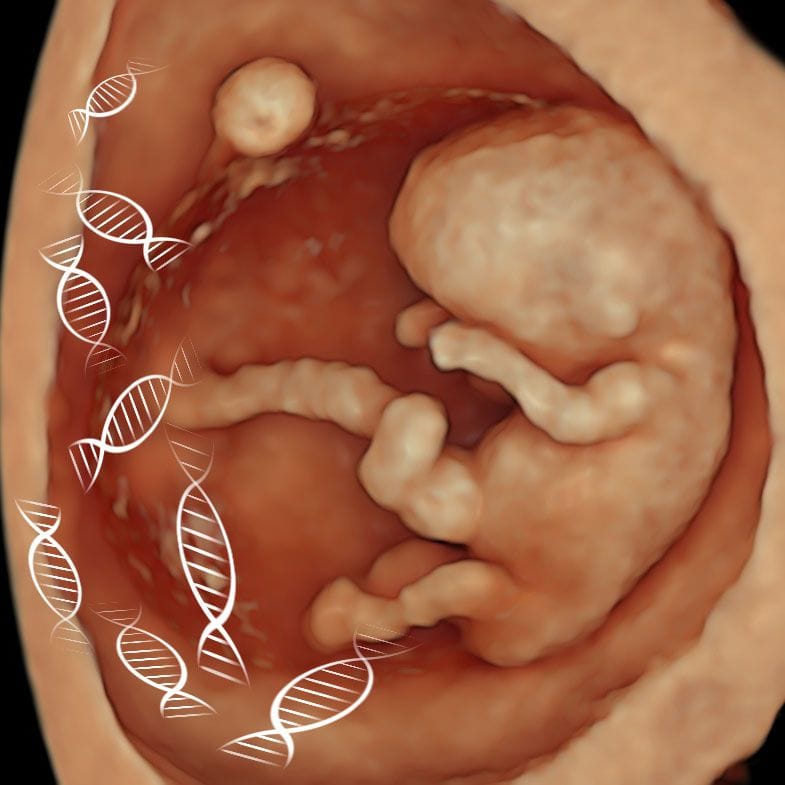
Far more than sex
What our NIPT tells you — from 9 weeks
A single blood test, reviewed by our specialists, gives you:
Your baby's sex, with very high accuracy
Screening for the three most common chromosomal conditions — Down's, Edwards' and Patau's syndromes
Sex-chromosome conditions such as Turner syndrome (where a girl is missing part or all of an X chromosome)
The option to add microdeletions — small missing pieces of DNA that can affect a baby’s development, such as DiGeorge syndrome (22q11.2) — with Extended Panorama
An ultrasound scan to confirm your dates and check your baby
A specialist review of your results and support if follow-up is needed
A clear reminder that NIPT is a screening test, not a diagnostic one — a higher-chance result is always confirmed with a diagnostic test (CVS or amniocentesis) after specialist counselling
When and how
When can I find out — and where?
Our Panorama NIPT can be performed from 9 weeks — among the earliest available NIPTs — and reports your baby’s sex as standard. If you are in London, we recommend pairing it with our 10-week anomaly scan so our specialists can also examine your baby’s anatomy.
Live outside London? Our NIPTs are available at more than 200 partner clinics across the UK through Jeen Health — so you can access the same clinical test, and the same expertise, close to home. See our full NIPT prices too.
Early gender testing — your questions
How early can a blood test tell the baby’s sex?
Our Panorama NIPT can determine fetal sex from 9 weeks with very high accuracy — and screens your baby’s health at the same time. Remember that NIPT is a screening test, not a diagnostic one: a higher-chance health result is always confirmed with a diagnostic test after specialist counselling.
Are home early-gender kits accurate?
Home gender kits are novelty products, not medical tests. They are not clinically reviewed, results can be affected by how the sample is taken, and they tell you nothing about your baby’s health. We recommend a clinical NIPT instead.
Can I find out the sex with a scan instead?
Yes — our gender scan can confirm your baby’s sex from later in pregnancy. For the earliest and most informative option, though, NIPT from 9 weeks is hard to beat.
Do I have to be told the sex?
Not at all. Sex reporting is optional — tell us your preference and we will respect it. Many parents choose NIPT purely for the health screening.
Get in touch
Want the full picture, not just the sex?
Sources & clinical references
The figures and clinical statements on this page are drawn from the sources below. Guidance evolves — always discuss your individual circumstances with a clinician.
- NHSScreening for the three most common chromosomal conditions — Down's, Edwards' and Patau's syndromes2024
- Ultrasound Obstet Gynecol (via PubMed)Analysis of cell-free DNA in maternal blood in screening for aneuploidies: updated meta-analysis2017
- GOV.UK (NHS Fetal Anomaly Screening Programme)Down's syndrome, Edwards' syndrome and Patau's syndrome2021