
Left-sided CDH
By far the most common form. The gap is usually in the back-left part of the diaphragm (a Bochdalek hernia), allowing bowel and sometimes the stomach and spleen to move into the left chest.
Congenital diaphragmatic hernia (CDH) is a rare condition in which a gap in the baby's diaphragm allows organs from the tummy to move up into the chest, which can affect how the lungs grow. It is one of the 11 physical conditions the NHS Fetal Anomaly Screening Programme looks for at the 20-week scan, and at London Pregnancy Clinic our fetal-medicine specialists can often raise suspicion of it earlier, during a detailed Early Fetal Scan or 10 Week Scan.
Congenital Diaphragmatic Hernia is one of the 11 conditions the NHS screens for at the 20-week scan — see our FASP overview and how we aim to detect anomalies earlier.
The diaphragm is a thin, dome-shaped sheet of muscle that separates the chest from the tummy and helps us breathe. In a congenital diaphragmatic hernia, this muscle does not form completely, leaving a gap. This usually happens very early in pregnancy, at around six to eight weeks, long before it can be seen on a scan.
Through that gap, organs that normally sit in the abdomen — most often part of the bowel, and sometimes the stomach, spleen or liver — can move up into the chest. Because these organs take up space the lungs need to grow, the lungs may not develop as fully as they should (this is called pulmonary hypoplasia). Most CDH is on the left side, which is the more common and generally more recognised pattern; right-sided and, rarely, both-sided hernias also occur.
CDH can happen on its own (isolated), or alongside other findings such as a chromosomal difference or another structural anomaly. Whether the hernia is isolated is one of the most important things the specialist team will try to establish, because it strongly shapes what the pregnancy and the period after birth are likely to involve.
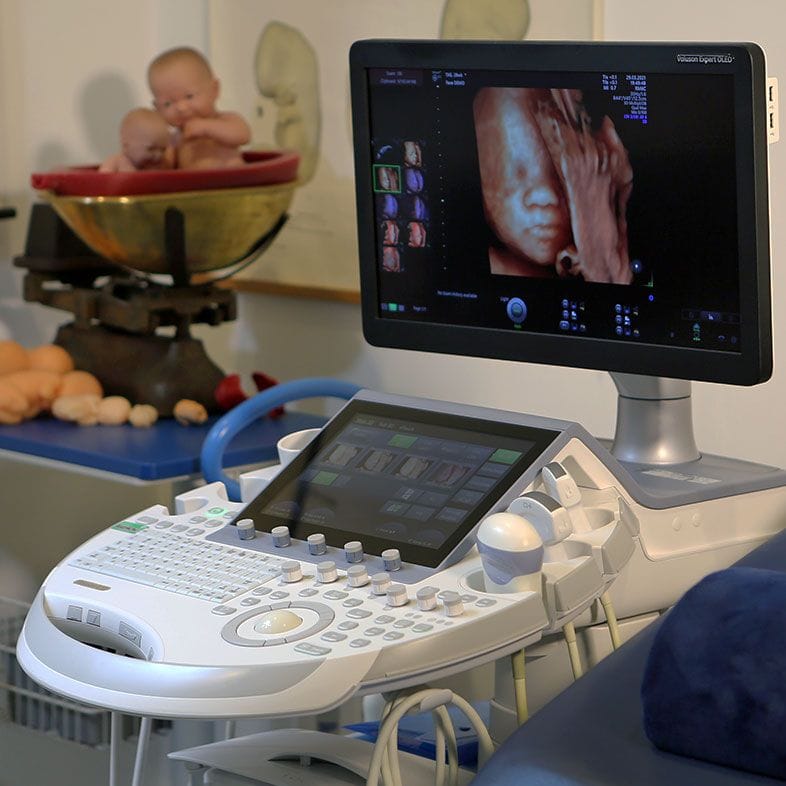
A congenital diaphragmatic hernia can often be seen on ultrasound during pregnancy. It is one of the 11 conditions the NHS Fetal Anomaly Screening Programme (FASP) specifically looks for at the 20-week scan, offered between 18+0 and 20+6 weeks. On the scan, clues include the stomach or bowel appearing at the same level as the heart within the chest, and the heart being pushed across to one side. If CDH is suspected, you will be referred to a fetal-medicine team and offered a further, detailed scan to confirm the diagnosis and to assess the lungs.
At London Pregnancy Clinic our angle is earlier, more detailed assessment. Our fetal-medicine specialists perform a thorough anatomy review at the Early Fetal Scan and the detailed 10 Week Scan, and in some cases the early signs of a diaphragmatic hernia — such as an unusual position of the stomach or heart — can raise suspicion well before the routine 20-week scan.
We are honest that not every case can be seen this early: CDH is sometimes only reliably confirmed later in pregnancy, and some hernias develop or become visible as the pregnancy progresses. Where we do raise a concern, we explain it clearly and help arrange the specialist follow-up and detailed assessment you need.
By far the most common form. The gap is usually in the back-left part of the diaphragm (a Bochdalek hernia), allowing bowel and sometimes the stomach and spleen to move into the left chest.
Less common, and can involve the liver moving up into the chest. Right-sided hernias can be harder to spot on ultrasound because the herniated liver looks similar to lung tissue.
Bochdalek (postero-lateral) hernias make up roughly 70-75% of cases; Morgagni (front of the diaphragm) hernias account for around 20-25%. The remainder are central defects. (Source: StatPearls)
CDH occurring on its own, with no other structural or chromosomal finding. This is the most favourable group, and prognosis depends largely on lung size and liver position.
CDH can occur alongside chromosomal differences or other anomalies. NHS information notes an associated condition, such as Down's syndrome, in up to about 1 in 10 cases. (Source: GOV.UK FASP)
Specialists assess prognosis using measurements such as the observed-to-expected lung-to-head ratio (O/E LHR) and whether the liver has moved into the chest — both help predict how the lungs are likely to cope after birth.
In most cases there is no single, identifiable cause, and nothing the parents did or did not do brought it on. The diaphragm simply does not close fully as it forms in early pregnancy, at around six to eight weeks. In some babies CDH is linked to an underlying chromosomal or genetic difference, which is one reason the specialist team may offer further testing.
It is often first suspected on ultrasound. CDH is one of the conditions specifically looked for at the NHS 20-week scan, where signs include the stomach or bowel appearing in the chest and the heart being pushed to one side. At London Pregnancy Clinic, a detailed early scan by a fetal-medicine specialist can sometimes raise suspicion earlier, though confirmation may still need a later, dedicated scan.
Sometimes. In a detailed Early Fetal Scan or 10 Week Scan, an experienced fetal-medicine specialist may notice early clues such as an abnormal position of the stomach or heart. We are careful not to overpromise, though: some diaphragmatic hernias are only reliably seen later in pregnancy, and a normal early scan does not completely rule CDH out. Where we do see something, we explain it clearly and arrange the right follow-up.
You will be referred to a fetal-medicine team for a detailed scan to confirm the diagnosis and assess the lungs. You may be offered an MRI scan to look more closely at the lungs, and an amniocentesis to check whether there is an underlying chromosomal cause. The team will also plan where and when your baby should be born so that specialist neonatal and surgical care is available straight away.
The main factors are whether the CDH is isolated, how much the lungs have been able to grow, and whether the liver has moved into the chest. Specialists use measurements such as the observed-to-expected lung-to-head ratio (O/E LHR) alongside liver position to gauge how the lungs are likely to cope. These assessments guide counselling and planning, and are best interpreted by the fetal-medicine team who know your individual pregnancy.
Babies with CDH need specialist care in a unit experienced in the condition to support their breathing after birth. Once the baby is stable, surgeons carry out an operation to move the organs back into the tummy and close the gap in the diaphragm. The timing depends on how well the baby is doing, and the specialist team will talk you through the plan for your baby.
For most families the chance of CDH happening again is low. NHS parent information puts the recurrence risk in a future pregnancy at around 2% for isolated CDH. If there is an underlying genetic cause, the team may discuss a different figure and can offer genetic counselling to talk this through. (Source: GOV.UK FASP)
These organisations provide trusted information and support relating to congenital diaphragmatic hernia.
The UK's dedicated congenital diaphragmatic hernia charity, offering information, emotional and practical support, and moderated peer groups for expectant parents, families and bereaved families. Freephone 0800 731 6991.
Details of CDH UK's ongoing support services, including closed peer-support groups for expectant parents, families of children with CDH, adult patients and bereaved families.
A national UK charity providing non-directive information and support to parents through antenatal screening and any decisions that follow a diagnosis such as CDH.
Contact
The figures and clinical statements on this page are drawn from the sources below. Guidance evolves — always discuss your individual circumstances with a clinician.
Cookies on this site
We use cookies needed to run this site. With your permission we would also use analytics and advertising cookies to see how the site is used and which of our adverts lead to bookings. Declining will not affect your care or your booking. See our Privacy notice and Terms & Conditions.