
The NHS Fetal Anomaly Screening Programme (FASP)

FASP is the NHS programme that offers every pregnant woman screening for a set of chromosomal and physical conditions. It has two parts: screening for Down's, Edwards' and Patau's syndromes in the first trimester, and the 20-week scan that checks for 11 conditions. Here we explain what the NHS looks for — and how our detailed early scans can often find many of these conditions sooner.

Screening is always your choice — see how our 10 Week Scan and early fetal scan complement the NHS pathway with earlier answers.

What is the NHS Fetal Anomaly Screening Programme?

The Fetal Anomaly Screening Programme (FASP) is the national NHS programme that offers screening to identify pregnancies at higher chance of certain conditions, so that parents can make informed choices and the right care can be planned. It is offered to every pregnant woman in England, but it is always a personal choice — you can accept all, some or none of the screening offered.

FASP screens for two groups of conditions: three chromosomal (genetic) conditions — Down's syndrome (trisomy 21), Edwards' syndrome (trisomy 18) and Patau's syndrome (trisomy 13) — and, at the 20-week scan, 11 conditions. Importantly, screening tells you the chance of a condition; it is not the same as a diagnosis.

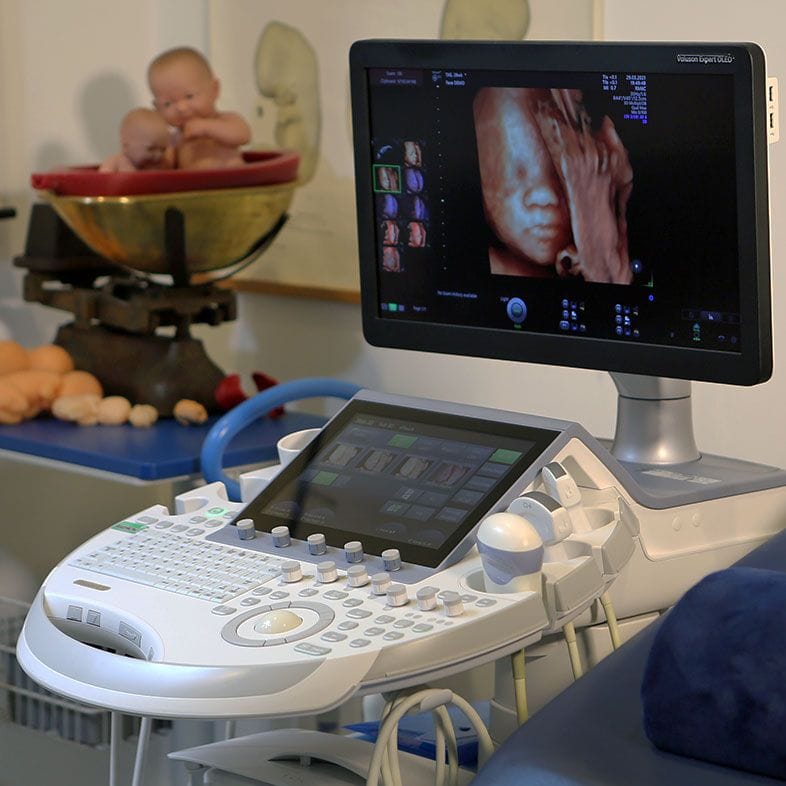
Ultrasound technology used in fetal anomaly screening
Ultrasound is central to both the NHS 20-week scan and our earlier detailed scans

What the NHS screens for — and when

For the three chromosomal conditions, the NHS offers the combined test between 10 and 14 weeks, which brings together a nuchal translucency ultrasound measurement, blood tests and your age to estimate the chance of Down's, Edwards' and Patau's syndromes. Where the scan is done later, a quadruple blood test is offered for Down's syndrome up to 20 weeks. If the result shows a higher chance (between 1 in 2 and 1 in 150), the NHS now offers non-invasive prenatal testing (NIPT) as a more accurate next step before any diagnostic test.

For the physical conditions, the NHS offers the 20-week screening scan (usually done between 18 and 20+6 weeks). A sonographer examines the baby's structure — the brain and spine, face, heart, abdomen, kidneys and bones — to look for 11 specific conditions. This scan is the main opportunity in the NHS pathway to identify structural anomalies, and for most women it is their last routine scan.

20-week scan

The 11 conditions the NHS 20-week scan looks for

The FASP 20-week scan screens for the following 11 conditions. We have a detailed page on each — including how it can often be identified earlier than 20 weeks:

The NHS 20-week scan vs London Pregnancy Clinic

The NHS programme is excellent and we encourage every parent to take up their NHS screening. Our scans are designed to complement it — with earlier timing, more time and more detail.

18–20+6 weeks

NHS FASP 20-week scan

Offered to everyone as part of NHS care. A structured sonographer-led scan that checks for the 11 conditions above and re-checks for Edwards' and Patau's syndromes. It usually takes place at around 20 weeks, is your last routine NHS scan, and focuses on this defined list of conditions.

From 10 weeks

London Pregnancy Clinic

Detailed scans performed by fetal-medicine specialists, starting from 10 weeks. Our 10 Week Scan and Early Fetal Scan examine the baby's structure far earlier, screening for a much wider range of anomalies, and can be paired with NIPT for chromosomal conditions — giving many parents answers weeks or months earlier than the 20-week scan.

How our approach is different — earlier and more comprehensive

Our founder Dr Fred Ushakov is an internationally recognised pioneer of first-trimester anomaly detection. Many conditions that the NHS looks for at 20 weeks — including anencephaly, spina bifida, large abdominal wall defects, major heart problems and severe skeletal dysplasias — can often be seen much earlier with a detailed, specialist-led scan. Our 10 Week Scan screens for a group of serious anomalies from as early as 10 weeks, and our Early Fetal Scan examines your baby head to toe, screening for over 100 structural anomalies well before the NHS 20-week scan.

Earlier answers matter: they give parents more time to understand a diagnosis, to arrange specialist care, and to make decisions with less time pressure. We are honest that not everything can be seen early — some heart, kidney and late-developing conditions are still best assessed later in pregnancy — which is why we also offer detailed later scans. Whatever your dates, our approach combines earlier timing, more scanning time and specialist expertise with the NHS pathway, not instead of it.

Detailed early fetal scan at London Pregnancy Clinic
Our Early Fetal Scan screens for over 100 structural anomalies — far earlier than 20 weeks

Our scans that go beyond FASP

Ways we help you get earlier, more detailed answers alongside your NHS screening:

10 Week Scan

The earliest detailed anomaly scan we offer, screening for a group of major physical anomalies and ideal to pair with NIPT — well before the NHS dating scan.

Early Fetal Scan

A comprehensive early anomaly scan examining your baby from head to toe, screening for over 100 structural anomalies much earlier than the 20-week scan.

NIPT

Non-invasive prenatal testing from a maternal blood sample from 10 weeks, screening for Down's, Edwards', Patau's and more with high accuracy.

Anomaly Scan

Our detailed 20-week anomaly scan, giving unhurried specialist time to examine your baby's structure and organs.

Your questions answered

What is the difference between screening and diagnosis?

Screening estimates the chance that a baby has a particular condition — it sorts pregnancies into higher-chance and lower-chance groups, but it does not give a yes-or-no answer. A diagnostic test, such as chorionic villus sampling (CVS) or amniocentesis, is needed to confirm or rule out a chromosomal condition for certain.

The NHS FASP combined test and 20-week scan are screening tests. If screening shows a higher chance, or the scan finds something, you would be offered further scans and, where relevant, a diagnostic test to find out more.

Which conditions does the NHS 20-week scan look for?

The 20-week scan screens for 11 conditions: anencephaly, spina bifida, cleft lip, congenital diaphragmatic hernia, gastroschisis, exomphalos, congenital heart disease, bilateral renal agenesis and lethal skeletal dysplasia, and it also looks again for Edwards' syndrome (T18) and Patau's syndrome (T13).

You can read a detailed page on each of these conditions above, including how each one is identified on ultrasound and how it can sometimes be seen earlier than 20 weeks.

Do I still need my NHS screening if I have private scans?

Yes — we recommend that you take up your NHS screening. Our scans are designed to work alongside the NHS pathway, giving you earlier and more detailed information, not to replace your NHS care.

Many of our patients have their private early scans and NIPT with us and continue with their NHS midwife-led care and 20-week scan as usual. We are always happy to liaise with your NHS team.

How early can these conditions be detected?

It depends on the condition. Some — such as anencephaly, large abdominal wall defects and severe skeletal dysplasias — can often be identified from around 10 to 13 weeks with a detailed specialist scan. Others, including some heart and kidney conditions and problems that develop later in pregnancy, are more reliably assessed at or after 20 weeks.

Our 10 Week Scan and Early Fetal Scan are designed to find as much as possible as early as it can safely and reliably be seen, and we will always be clear about what can and cannot be assessed at your stage of pregnancy.

Is fetal anomaly screening compulsory?

No. All antenatal screening is offered to you, and it is your choice whether to have all, some or none of it. NHS staff should give you clear information so you can make a personal, informed decision.

The same applies to our scans — we will explain what each scan can and cannot tell you so you can decide what is right for you and your family.

What happens if something is found?

If a scan raises a concern, you would usually be offered a detailed follow-up scan, and depending on the finding, referral to a fetal medicine specialist, a fetal heart scan, or genetic testing. Our specialists can explain the finding, arrange the right next steps, and support you through your options.

Organisations such as Antenatal Results and Choices (ARC) also offer independent, non-directive support to parents through screening and diagnosis.

Contact

Want earlier answers alongside your NHS screening?

Send us an enquiry

A clinician will reply within one working day.

For urgent matters please call 020 3687 2939.

Sources & clinical references

The figures and clinical statements on this page are drawn from the sources below. Guidance evolves — always discuss your individual circumstances with a clinician.

  1. NHS England (GOV.UK)Fetal anomaly screening programme (FASP): programme overview2026
  2. NHS20-week screening scan2023
  3. NHSScreening for Down's, Edwards' and Patau's syndromes2023