Lethal Skeletal Dysplasia Diagnosis

Lethal skeletal dysplasia is a group of severe genetic conditions that affect how a baby's bones grow, leaving the chest very small and the limbs very short. It is one of the 11 physical conditions the NHS Fetal Anomaly Screening Programme looks for at the 20-week scan, and at London Pregnancy Clinic our fetal-medicine specialists can often raise suspicion of it earlier, during our detailed 10 Week Scan or Early Fetal Scan.

Lethal Skeletal Dysplasia is one of the 11 conditions the NHS screens for at the 20-week scan — see our FASP overview and how we aim to detect anomalies earlier.

Lethal Skeletal Dysplasia: Key Information

"Skeletal dysplasia" is an umbrella term for a large family of conditions that change the way a baby's bones form and grow. Most are compatible with a full life, but a small number are so severe that the bones and, crucially, the chest cannot develop enough to support breathing after birth. These are the conditions grouped together as lethal (or severe) skeletal dysplasia. Because the ribcage stays very small, the lungs do not have room to grow, and sadly most affected babies do not survive around the time of birth.

The best-known example is thanatophoric dysplasia, the most common lethal skeletal dysplasia, which is caused by a change in a single gene called FGFR3. Other conditions in this group include achondrogenesis and osteogenesis imperfecta type II, a severe form in which the bones are fragile and can fracture before birth. Each has its own genetic cause, but they share a similar picture on ultrasound: markedly short limbs, a narrow chest, and sometimes reduced bone density or fractures.

Most of these conditions arise from a brand-new (de novo) genetic change that was not inherited from either parent, which means they can occur in a pregnancy with no family history at all. A diagnosis is never anyone's fault, and it does not usually mean a high chance of the same thing happening again — though the specialist team will always talk this through with you individually.

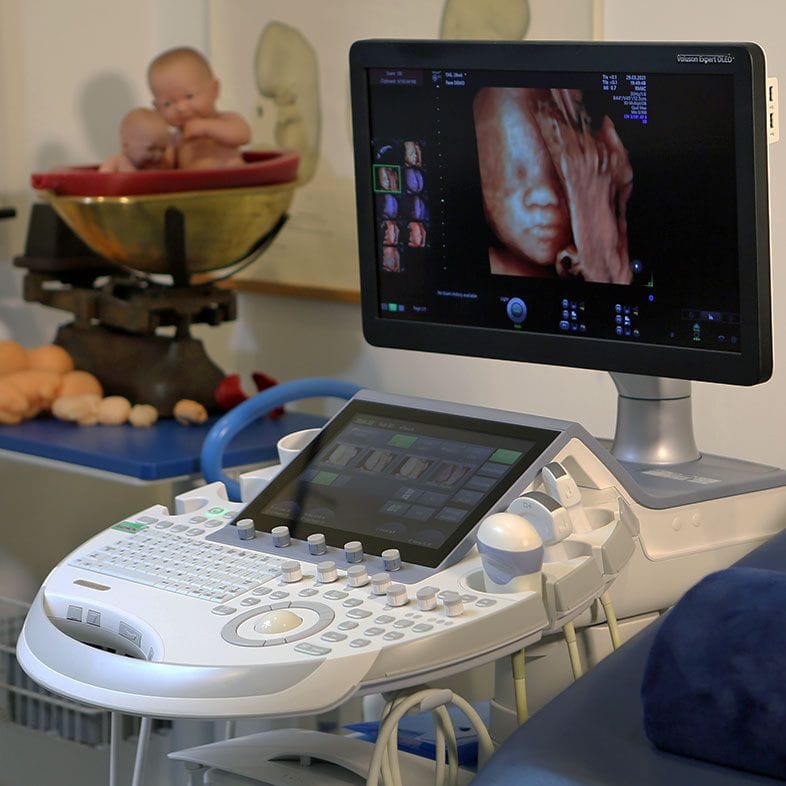
Ultrasound used to diagnose lethal skeletal dysplasia
Ultrasound is a powerful tool for identifying fetal anomalies

How lethal skeletal dysplasia is diagnosed

Lethal skeletal dysplasia is one of the 11 physical conditions the NHS Fetal Anomaly Screening Programme (FASP) screens for at the routine 20-week scan, carried out between 18 and 21 weeks of pregnancy.

On ultrasound it shows itself through very short limbs (limb length below the 5th centile), a small, narrow chest with short ribs, and sometimes bowed or fractured bones or reduced ossification where the bone appears too dark.

If the 20-week scan raises a concern, you are referred to a fetal-medicine specialist team who offer further detailed scans and can confirm the diagnosis with a test such as chorionic villus sampling (CVS) or amniocentesis.

At London Pregnancy Clinic our angle is earlier, more detailed assessment.

Because our 10 Week Scan and Early Fetal Scan are performed by fetal-medicine specialists using high-resolution equipment, severely short limbs, a small chest or an increased nuchal translucency can sometimes prompt suspicion of a skeletal dysplasia well before 20 weeks — occasionally as early as the 11-to-14-week window.

We are honest that this is not guaranteed: some skeletal changes only become measurable later in pregnancy, so a reassuring early scan does not replace the 20-week anomaly scan. What earlier assessment can offer is more time — time to see the specialist team, to arrange genetic testing, and to make decisions with the fullest possible information and support.

Lethal Skeletal Dysplasia statistics

1 of 11 physical conditions the NHS screens for at the 20-week scan, of which lethal skeletal dysplasia is one (Source: GOV.UK NHS FASP overview)
~1 in 10,000 babies affected by a severe skeletal dysplasia (Source: GOV.UK, severe skeletal dysplasia information for parents)
~1 in 20,000 births affected by thanatophoric dysplasia, the most common lethal skeletal dysplasia (Source: GeneReviews, NCBI)
18–21 weeks when the routine NHS 20-week anomaly scan takes place, between 18+0 and 20+6 weeks (Source: GOV.UK NHS FASP overview)
11–14 weeks when a detailed specialist early scan can sometimes first raise suspicion of a severe skeletal dysplasia

Conditions within the lethal skeletal dysplasia group

Thanatophoric dysplasia

The most common lethal skeletal dysplasia, caused by a change in the FGFR3 gene. Babies have very short limbs, a narrow chest and a large head; type 1 has curved (bowed) thigh bones, while type 2 features straight thigh bones and a cloverleaf-shaped skull.

Achondrogenesis

A rare, severe group of dysplasias with extremely short limbs, a very small chest and markedly reduced bone formation (ossification), so bones such as the spine and pelvis appear faint on ultrasound and X-ray.

Osteogenesis imperfecta type II

The severe, perinatally lethal form of "brittle bone disease", in which bones are so fragile that multiple fractures can occur before birth, alongside short, bowed limbs and a small, under-developed chest.

Short-rib thoracic dysplasias

A group in which very short ribs leave the chest too narrow for the lungs to expand; some subtypes also include extra fingers or toes. Severity varies, and the most severe forms are life-limiting.

Small chest and lung underdevelopment

The shared final pathway across these conditions: because the ribcage cannot grow enough, the lungs stay small (pulmonary hypoplasia). This is the main reason most affected babies cannot survive after birth, rather than the short limbs themselves.

The FGFR3 gene

A gene that normally acts as a brake on bone growth. Overactive changes in FGFR3 cause thanatophoric dysplasia as well as milder conditions such as achondroplasia, which is why genetic testing is central to pinpointing the exact diagnosis.

Your questions answered

What does "lethal" skeletal dysplasia actually mean?

It is a group of the most severe bone-growth conditions, in which the chest is too small for the lungs to develop enough to support breathing after birth. Sadly, most babies with a lethal skeletal dysplasia are stillborn or die soon after birth, and there is no treatment that can reverse it.

We know how heavy those words are. The specialist fetal-medicine team, together with charities such as ARC, are there to support you through understanding the diagnosis and whatever decisions follow, at your own pace.

Is lethal skeletal dysplasia something I could have caused or passed on?

No. Most of these conditions, including thanatophoric dysplasia, are caused by a brand-new genetic change that happens spontaneously and was not inherited from either parent. Nothing you did or did not do in pregnancy causes it.

Because the change is usually new, it typically does not mean a high chance of the same condition in a future pregnancy — but a clinical geneticist can give you advice specific to your situation.

Can it be seen before the 20-week scan?

Sometimes, yes. Very short limbs, a small chest or an increased nuchal translucency measurement can raise suspicion during a detailed early scan, occasionally as early as 11 to 14 weeks. At London Pregnancy Clinic our 10 Week Scan and Early Fetal Scan are performed by fetal-medicine specialists precisely so that concerns can be picked up sooner where possible.

We are careful not to overpromise: some skeletal changes only become measurable as the pregnancy progresses, so an early scan that looks normal does not rule the condition out, and the 20-week anomaly scan remains important.

How is the diagnosis confirmed?

If a scan raises concern, a fetal-medicine specialist will offer more detailed ultrasound assessment, looking closely at limb lengths, the chest and rib size, bone density and the skull shape.

A definitive diagnosis of the specific condition usually needs genetic testing on a sample obtained by chorionic villus sampling (CVS) or amniocentesis. This can identify the exact gene involved, such as FGFR3 in thanatophoric dysplasia.

How common is lethal skeletal dysplasia?

Severe skeletal dysplasias affect around 1 in 10,000 babies overall. Thanatophoric dysplasia, the most common single type, occurs in roughly 1 in 20,000 births.

Because these conditions usually arise from new genetic changes, they can happen in any pregnancy, including where there is no family history of bone problems.

What support is available if we receive this diagnosis?

You will be cared for by a specialist fetal-medicine team and can be referred for genetic counselling. National charities also provide dedicated, non-judgemental support — Antenatal Results and Choices (ARC) supports parents through screening results and the decisions that follow, whatever you decide.

Whether you choose to continue the pregnancy with palliative care planning or to end it, you deserve compassionate, unhurried support, and you do not have to face any of it alone.

Will the same thing happen in another pregnancy?

For most lethal skeletal dysplasias caused by a new (de novo) genetic change, the chance of recurrence in a future pregnancy is low. Some rarer conditions in this group are inherited differently, so recurrence risk can vary.

A clinical geneticist can review the specific diagnosis and give you a personal recurrence figure, and where a gene has been identified, early testing can be offered in any future pregnancy.

Support Resources

These organisations provide trusted information and support relating to lethal skeletal dysplasia.

Antenatal Results and Choices (ARC)

A national UK charity offering non-directive information and emotional support to parents throughout antenatal screening and testing, and to anyone making decisions after a diagnosis. Helpline: 020 7713 7486, Monday to Friday.

Restricted Growth Association UK (RGA)

A long-established UK charity supporting individuals and families affected by skeletal dysplasia and restricted growth, offering information, community and advocacy across the many conditions that affect bone growth.

Together for Shorter Lives

A UK charity supporting families of babies and children with life-limiting and life-threatening conditions, including help with palliative and end-of-life care planning where a pregnancy is continued.

Contact

Do you want to know more about your options?

Send us an enquiry

A clinician will reply within one working day.

For urgent matters please call 020 3687 2939.

Sources & clinical references

The figures and clinical statements on this page are drawn from the sources below. Guidance evolves — always discuss your individual circumstances with a clinician.

  1. GOV.UK / NHS Fetal Anomaly Screening ProgrammeSevere skeletal dysplasia: information for parents2023
  2. GOV.UK / NHS FASPFetal anomaly screening programme: programme overview (11 conditions screened at the 20-week scan)2023
  3. GeneReviews, NCBI BookshelfThanatophoric Dysplasia2020
  4. NHS Genomics Education ProgrammePresentation: pregnancy with suspicion of a skeletal dysplasia2023
  5. jeen.healthFGFR3 gene profile