
Repeat sampleNo extra charge if the laboratory cannot give a result
Low fetal fraction and NIPT ‘no result’
What a no-call means, why it happens and what happens next
Occasionally a non-invasive prenatal test (NIPT) comes back without an answer. The laboratory may call it a ‘no-call’, ‘no result’, ‘non-reportable’ or ‘test failure’, and the most common reason is a low fetal fraction — too little DNA from the pregnancy in your blood sample to give a reliable reading. This guide explains what fetal fraction is, why it can be low, how often it happens and what your options are. For the basics of the test itself, see our main NIPT page.
A no-call is worrying to receive, but it is not a diagnosis. Most no-call results happen in pregnancies without a chromosomal condition, and many people get a clear result from a repeat sample. Because a low fetal fraction is linked with a higher chance of a few specific chromosomal conditions, professional guidance says it should be followed up rather than ignored. You can read how to interpret every type of report in NIPT results explained.
Scan includedEvery NIPT comes with an ultrasound and specialist review
Available atLPC City (E1)LPC West (SW10)
At a glance
A no-call NIPT result in brief
If your NIPT has come back without a result, these are the key points to know before reading further.
- A no-call means the laboratory could not issue a reliable result. The most common reason is a low fetal fraction — too little DNA from the pregnancy in the sample.
- Fetal fraction tends to be lower earlier in pregnancy, at a higher body weight, in IVF and twin pregnancies, and in people taking anticoagulant (blood-thinning) injections such as heparin.
- Most no-call results happen in pregnancies without a chromosomal condition. Low fetal fraction has, however, been linked with a higher chance of Edwards’ syndrome, Patau’s syndrome, monosomy X and triploidy — but not Down’s syndrome.
- Guidance from the International Society for Prenatal Diagnosis (ISPD) describes the usual options as a detailed ultrasound, a repeat NIPT, an alternative screening test and/or a diagnostic test.
- At the London Pregnancy Clinic, a repeat blood sample after a no-call is taken at no extra cost. If the second sample also gives no result, we refund the NIPT portion of your appointment and talk you through your options.
The basics
What is fetal fraction?
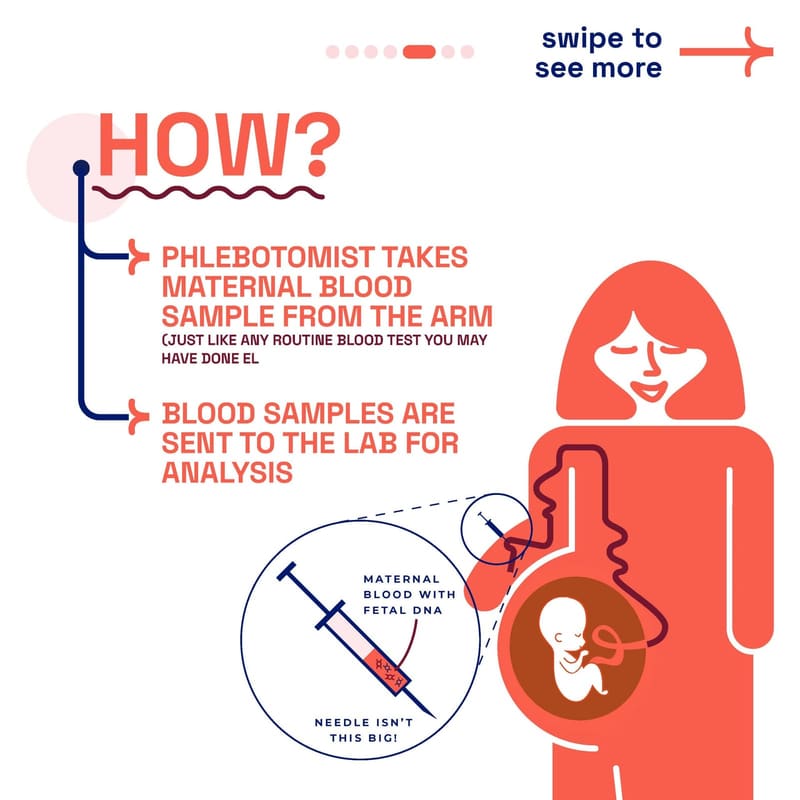
During pregnancy your blood contains tiny fragments of free-floating DNA, called cell-free DNA. Most of it is your own, but a proportion comes from the placenta, which usually shares the baby’s genetic make-up. NIPT analyses this mixture to estimate the chance of certain chromosomal conditions.
The fetal fraction is the percentage of all the cell-free DNA in your sample that comes from the placenta. The International Society for Prenatal Diagnosis describes it as an important quality-control measure, because the lower it is, the harder it becomes for the laboratory to tell a pregnancy with a chromosomal condition from one without.
In a large study of more than 10,000 singleton pregnancies tested at 10–14 weeks at King’s College Hospital, London, the typical (median) fetal fraction in unaffected pregnancies was 11 per cent. A separate laboratory study of more than 22,000 samples found a median of about 10 per cent at 10 weeks. Fetal fraction varies a great deal from person to person, and even between samples from the same person.
Because NIPT reads DNA from the placenta rather than directly from the baby, it remains a screening test. Any higher-chance result needs confirming with a diagnostic test before decisions are made — see NIPT results explained.
Laboratory cut-offs
How low is too low? Fetal fraction thresholds
There is no single, universal cut-off. Each laboratory sets its own minimum fetal fraction below which it will not issue a result. According to the ISPD’s 2023 position statement, that threshold depends on the laboratory’s technology and analysis methods, and on the characteristics of the individual sample. The statement also notes that fetal fraction measurement is imprecise and that the threshold below which a result cannot be issued varies substantially between laboratories.
Many published studies have used 4 per cent as the point below which a result is not reported, while other laboratories and methods use different thresholds. That is why the same fetal fraction can produce a result with one test and a no-call with another, and why comparing percentages between different laboratories’ reports is not straightforward.
Your report may not state a percentage at all. The wording varies — ‘low fetal fraction’, ‘insufficient fetal DNA’, ‘no-call’, ‘non-reportable’ and ‘test failure’ generally describe the same situation. Our team will explain what your particular report means. If you are choosing between tests, our NIPT comparison guide sets out how the options we offer differ.
Causes
Why fetal fraction can be low
A low fetal fraction is usually down to ordinary biological differences rather than anything you have done. Research has identified several factors that make it more likely.
Earlier gestation
Fetal fraction rises as pregnancy progresses, and a 2022 systematic review found that a lower gestational age was significantly associated with low fetal fraction. In one large laboratory study it increased by around 0.1 per cent a week between 10 and 21 weeks, and faster after that — one reason accurate dating by ultrasound matters.
Higher body weight
Large studies, including a London study of more than 10,000 pregnancies and a laboratory study of more than 22,000 samples, found that fetal fraction tends to be lower at a higher body weight or BMI. It is a biological effect, not a reflection of how you are looking after yourself or your pregnancy.
Anticoagulant medicines
In a US study of 1,707 pregnant people, the 29 who were taking anticoagulants such as low-molecular-weight heparin had a lower fetal fraction and a much higher rate of indeterminate results (17.2 per cent compared with 2.7 per cent). The anticoagulant group was small, but the link held after allowing for BMI and gestational age. Aspirin alone did not raise the rate of indeterminate results. Please never stop a prescribed medicine to improve a test result.
IVF and twin pregnancies
Fetal fraction is lower on average after assisted conception such as IVF. In a London study, first samples from twin pregnancies failed more often than singleton samples (9.4 per cent compared with 2.9 per cent), and the researchers found IVF conception was the main reason.
Other maternal factors
The same London study found fetal fraction was lower with increasing maternal age and in women of South Asian background, and higher when blood markers of placental function were higher. The ISPD also lists certain maternal medical conditions as factors.
Some chromosomal conditions
Some chromosomal conditions are associated with a systematically lower fetal fraction. This has been linked with Edwards’ syndrome (trisomy 18), Patau’s syndrome (trisomy 13), monosomy X and triploidy (an extra full set of chromosomes). It does not appear to apply to Down’s syndrome. See ‘What a no-call can mean’ below.
How often
How common are no-call results?
No-call rates differ between laboratories, testing methods and groups of patients, so treat these published figures as a guide rather than a prediction for any one person.
2.9% of first samples gave no result in unaffected singleton pregnancies tested at 10–14 weeks (King’s College Hospital, London; more than 10,000 pregnancies)
9.4% of first samples gave no result in twin pregnancies in the same London research programme, mainly linked to IVF conception
56% of repeat samples had enough fetal DNA (above 4%) after an initial low result, in a laboratory series of 135 redraws
1–2% of pregnancies with low fetal fraction had a chromosomal condition, according to a 2023 meta-analysis of 27 studies
Putting it in context
What a no-call can mean for your baby
The most important point first: most no-call results occur in pregnancies that do not have a chromosomal condition. A 2023 meta-analysis of 27 studies, covering more than 240,000 singleton pregnancies, found that chromosomal conditions were present in around 1 to 2 in every 100 pregnancies with a low fetal fraction. Put the other way round, the large majority were unaffected.
That said, a low fetal fraction is not completely neutral. The same meta-analysis found it was associated with a higher chance of trisomy 13 (Patau’s syndrome), trisomy 18 (Edwards’ syndrome), monosomy X (Turner syndrome) and triploidy. The London study of more than 10,000 pregnancies found the same pattern: first-sample failures were more common in trisomy 18 (8.0 per cent) and trisomy 13 (6.3 per cent) than in unaffected pregnancies (2.9 per cent).
There was no such link with trisomy 21 (Down’s syndrome) in either study. In the London cohort, pregnancies with Down’s syndrome actually had a slightly lower failure rate than unaffected pregnancies.
The 1 to 2 per cent figure is an average across many groups of patients. Your own chance may be higher if the fetal fraction was very low, or if the pregnancy was already at higher chance — for example after a higher-chance combined test or an unexpected finding on the scan. A US study concluded that when a result fails because of low fetal fraction, the chance of trisomy 18 or triploidy is high enough to warrant further assessment such as ultrasound, and that if the test was done because of a scan abnormality, diagnostic testing such as amniocentesis should be considered.
This is why the ISPD describes a no-call as a clinical dilemma: it is associated with an increased chance of fetal aneuploidy (an abnormal number of chromosomes) or other adverse outcomes, even though most pregnancies with a no-call turn out to be unaffected. Conditions such as trisomy 18, trisomy 13 and triploidy often show features on a detailed ultrasound, which is why the scan is such an important part of the follow-up. The London researchers concluded that decisions about diagnostic testing after a failed result should depend on the findings of detailed ultrasound and any earlier screening.
At the London Pregnancy Clinic
What happens next if your NIPT gives no result
We contact you
If the laboratory cannot issue a result, we contact you directly. We may ask you to come in for another blood sample, or ask for more information about your pregnancy or medical history — for example whether you take heparin or conceived by IVF.
We review your scan
Every NIPT at our clinic is booked with an ultrasound scan. A specialist reviews those findings alongside the laboratory report, because a detailed early scan can pick up features of the conditions linked with a low fetal fraction.
Repeat sample at no extra cost
We arrange another appointment to take a repeat blood sample, free of charge. Our clinician will advise on timing, since fetal fraction rises as pregnancy progresses.
If there is still no result
If the second sample also gives no result, we refund the NIPT portion of your appointment (the scan is not refundable) and discuss alternative screening and/or referral for diagnostic testing. We have the same discussion if you choose not to have a second attempt.
Your choices
Options after a repeat no-call
If a repeat sample also fails, or you would rather not try again, you still have choices. None of them is compulsory, and the right path depends on your scan findings, any earlier screening results and what matters to you. The options below reflect ISPD guidance and the NHS screening pathway.
- A detailed ultrasound scan. A detailed early scan such as our 10-week scan looks for structural differences, some of which are linked with trisomy 18, trisomy 13 and triploidy. A later nuchal or anomaly scan adds further information.
- An alternative screening test. The first-trimester combined test, which uses a blood test and the nuchal translucency measurement from the 12-week scan, does not depend on fetal fraction. It is offered free on the NHS, usually between 10 and 14 weeks.
- Genetic counselling. A genetic counsellor can explain what a no-call means for you, weigh up the options and support your decision without pressure — see our NIPT genetic counselling service, or book an online 30-minute genetic counselling appointment directly.
- Diagnostic testing. Chorionic villus sampling (CVS) or amniocentesis examines the baby’s chromosomes directly and gives a definite answer. Both carry a small chance of miscarriage — the NHS puts it at about 1 in 200 after amniocentesis and less than 1 in 200 after CVS for most pregnancies, and higher in twin pregnancies.
- No further testing. Choosing not to have more tests is a valid option, and you will continue to be offered routine scans in your pregnancy.
NHS screening
If you had NIPT on the NHS
On the NHS, NIPT is offered free of charge to people whose combined or quadruple screening test gives a higher-chance result for Down’s, Edwards’ or Patau’s syndrome, in single and twin pregnancies. Screening with the combined test is offered to everyone who is pregnant in England.
The NHS screening programme recognises that NIPT sometimes produces no result. Its pathway requirements say that anyone who receives a ‘no result’ NIPT should be seen within 3 working days of the maternity service receiving the result, to discuss one further NIPT, prenatal diagnosis or no further testing.
If your NHS NIPT gave no result, your maternity team is the right first point of contact. Some people also choose a private scan or genetic counselling for extra information or reassurance — we are happy to help alongside your NHS care.
Before your test
Can you reduce the chance of a no-call?
There is no proven way to raise your own fetal fraction, and for most people a no-call cannot be predicted in advance. A few practical steps may help avoid an unnecessary repeat appointment.
- Make sure your pregnancy is accurately dated. The laboratory needs the gestational age confirmed by ultrasound, and the scan measurement (crown–rump length) can differ from the date of your last period.
- Leave a small margin after the minimum gestation. We recommend booking NIPT from 10 weeks + 2 days, or 9 weeks + 2 days for Panorama.
- Tell us at booking if you take heparin or another anticoagulant, conceived by IVF, or are expecting twins, so that we can discuss the test options with you.
- Do not stop or change any prescribed medication to improve a test result.
If you are unsure how far along you are, a dating scan first can help us arrange your NIPT for the right time. Our main NIPT page explains timing and the tests we offer.
Low fetal fraction and no-call results — your questions
What is a normal fetal fraction for NIPT?
There is no single ‘normal’ figure, because fetal fraction varies widely between people and rises through pregnancy. In a large London study of pregnancies tested at 10–14 weeks, the median in unaffected pregnancies was 11 per cent. A laboratory study found a median of about 10 per cent at 10 weeks.
What fetal fraction is too low for NIPT?
It depends on the laboratory. Each one sets its own minimum according to its technology and analysis methods, and the ISPD notes that fetal fraction measurement is imprecise and that these thresholds vary substantially between laboratories. Many published studies have used 4 per cent as the cut-off, but other laboratories and methods use different thresholds. Your report may simply say the result could not be issued.
Does a no-call NIPT result mean something is wrong with my baby?
Not usually. Most no-call results occur in pregnancies without a chromosomal condition — a 2023 meta-analysis found chromosomal conditions in around 1 to 2 in 100 pregnancies with a low fetal fraction. However, low fetal fraction is linked with a higher chance of trisomy 18, trisomy 13, monosomy X and triploidy, and the chance is higher again if the pregnancy was already at higher chance or the scan showed a concern. That is why we follow it up with a scan review and a discussion of your options rather than simply waiting.
Is low fetal fraction linked to Down’s syndrome?
The published evidence suggests not. Both a large London study and a 2023 meta-analysis found no link between low fetal fraction and trisomy 21. The associations were with trisomy 18, trisomy 13, monosomy X and triploidy.
How likely is a repeat NIPT to give a result?
Many people get a result from a second sample, but not everyone. In one laboratory series of 135 repeat samples taken after an initial low fetal fraction, 56 per cent had enough fetal DNA the second time. The chance varies from person to person. Our clinician will advise on the best timing for your repeat sample.
Do I have to pay for a repeat NIPT after a no-call?
No. If the laboratory cannot give a result, we arrange another appointment to take a repeat blood sample free of charge. If the second sample also gives no result, we refund the NIPT portion of your appointment (the scan is not refundable). Full details are in the refund policy on our NIPT page.
I take heparin injections. Should I stop them before NIPT?
No — please do not stop or change any prescribed medication to improve a test result. Heparin is prescribed for important reasons in pregnancy. Research suggests anticoagulants can lower fetal fraction and make a no-call more likely, so let us know at booking, and discuss any questions about your medication with the doctor who prescribed it.
Is NIPT more likely to fail in twin or IVF pregnancies?
Yes, on average. In a London study, first samples from twin pregnancies failed more often than those from singletons (9.4 per cent compared with 2.9 per cent), mainly because more of the twin pregnancies were conceived by IVF, which is linked with a lower fetal fraction. NIPT can still be a useful option — our team can talk you through it before you book.
Can I have the combined test instead if NIPT does not work?
Yes. The first-trimester combined test does not depend on fetal fraction, and the ISPD lists it as an alternative after a no-call. It is offered free on the NHS, usually between 10 and 14 weeks. Timing matters, so it is worth discussing promptly with your midwife or our team. You can read about the nuchal translucency measurement on our nuchal scan page.
A note on this information
This information is intended for general educational purposes only and does not constitute medical advice. Please consult a qualified healthcare professional for guidance specific to your individual circumstances. If you have concerns about your pregnancy or baby’s wellbeing, contact your midwife, GP or maternity unit promptly.
Get in touch
Had a no-call result? Talk it through with our team
Sources & clinical references
The figures and clinical statements on this page are drawn from the sources below. Guidance evolves — always discuss your individual circumstances with a clinician.
- Prenatal Diagnosis (ISPD position statement, Hui et al., via PubMed)Position statement from the International Society for Prenatal Diagnosis on the use of non-invasive prenatal testing for the detection of fetal chromosomal conditions in singleton pregnancies2023
- Ultrasound in Obstetrics & Gynecology (Revello et al., King’s College Hospital, via PubMed)Screening for trisomies by cell-free DNA testing of maternal blood: consequences of a failed result2016
- Ultrasound in Obstetrics & Gynecology (Sarno et al., King’s College Hospital, via PubMed)Prospective first-trimester screening for trisomies by cell-free DNA testing of maternal blood in twin pregnancy2016
- Prenatal Diagnosis (Becking et al., via PubMed)Association between low fetal fraction in cell-free DNA screening and fetal chromosomal aberrations: a systematic review and meta-analysis2023
- Prenatal Diagnosis (Wang et al., via PubMed)Gestational age and maternal weight effects on fetal cell-free DNA in maternal plasma2013
- BMC Pregnancy and Childbirth (Mousavi et al., via PubMed)Factors affecting low fetal fraction in fetal screening with cell-free DNA in pregnant women: a systematic review and meta-analysis2022
- American Journal of Obstetrics & Gynecology (Shree et al., via PubMed)Anticoagulation use is associated with lower fetal fraction and more indeterminate results2024
- Prenatal Diagnosis (Palomaki et al., via PubMed)Circulating cell free DNA testing: are some test failures informative?2015
- GOV.UK (NHS Fetal Anomaly Screening Programme)Down’s syndrome, Edwards’ syndrome and Patau’s syndrome screening pathway requirements specification2025
- GOV.UK (NHS Fetal Anomaly Screening Programme)NIPT for Down’s syndrome, Edwards’ syndrome and Patau’s syndrome: summary information2025
- NHSScreening for Down’s syndrome, Edwards’ syndrome and Patau’s syndrome2025
- NHSChorionic villus sampling (CVS): risks2023
- NHSAmniocentesis: risks2023