hCG Levels by Week

hCG is the pregnancy hormone that every pregnancy test detects. Below are the typical blood hCG ranges for each week of pregnancy — but the ranges are so wide that a single result, on its own, tells you very little. What clinicians look at is how your level changes over 48 hours, and what an ultrasound scan shows.

Have two results already? Our beta hCG doubling time calculator works out your doubling time and 48-hour rise in seconds.

Available atLPC City (E1)

Pain or bleeding? Do not wait for a blood result

Call 999 or go to A&E if you have sudden, sharp and intense tummy pain, feel very dizzy or faint, feel sick, or look very pale — the NHS lists these as signs of a possible ruptured ectopic pregnancy. For pain low down on one side, bleeding or brown watery discharge, pain in the tip of your shoulder, or discomfort when peeing or pooing, contact your GP, NHS 111 or your local early pregnancy unit the same day. NHS early pregnancy assessment services investigate these symptoms free of charge, with hCG blood tests and a scan where needed.

What hCG is, and how it is measured

Human chorionic gonadotrophin (hCG) is the hormone of early pregnancy. It is made by the cells that go on to form the placenta, and the NHS notes that it starts to be produced around 6 days after fertilisation. Every pregnancy test — the stick you use at home and the blood test in a clinic — works by detecting it.

A home urine test answers one question: is hCG there or not? A quantitative blood test, often called a beta hCG test, measures how much is in your bloodstream, reported in milli-international units per millilitre (mIU/mL). NICE guidance writes the same result in IU/L. The two units are numerically identical, so 1,500 IU/L is the same as 1,500 mIU/mL.

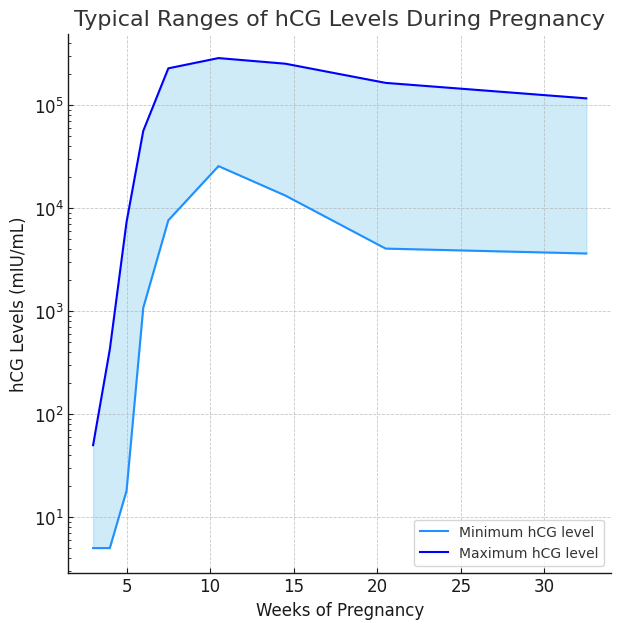
Outside pregnancy, blood hCG is normally below 5 mIU/mL (MedlinePlus), and a level above 25 mIU/mL usually means you are pregnant (Cleveland Clinic). In a developing pregnancy, hCG then climbs quickly, peaks at around 10 weeks and gradually falls for the rest of the pregnancy (Cleveland Clinic).

Typical hCG levels by week of pregnancy

These are the ranges published by Cleveland Clinic, counted in weeks since the first day of your last period — the way pregnancy is normally dated, so 4 weeks is roughly when a period is missed. Before reading anything into your own result, look at how wide each band is.

WeekhCG (mIU/mL)
3 weeks5–50
4 weeks5–426
5 weeks18–7,340
6 weeks1,080–56,500
7 – 8 weeks7,650–229,000
9 – 12 weeks25,700–288,000
13 – 16 weeks13,300–254,000
17 – 24 weeks4,060–165,400
25 – 40 weeks3,640–117,000

Source: Cleveland Clinic. Reference ranges vary between laboratories (MedlinePlus), so compare your result with the range on your own report, and have it interpreted by a clinician alongside your symptoms and any scan.

The bands overlap heavily from one week to the next, so hCG cannot reliably tell you how far along you are. An early scan can — see our viability and dating scan or the pregnancy due date calculator.

Why one hCG result tells you very little

At 5 weeks, a pregnancy can have an hCG anywhere from 18 to 7,340 mIU/mL — roughly a 400-fold spread. Two women at the same stage can have very different results, and both can be entirely well. The dates add their own uncertainty: NICE points out that your last period may not reflect how far along you really are, because menstrual cycles vary.

So a result that looks low for your dates is not, on its own, a diagnosis, and a result that looks high is not, on its own, a sign of twins or a problem. What carries meaning is change. That is why UK guidance (NICE NG126) asks for two blood samples taken as close as possible to 48 hours apart — but no earlier.

Clinicians then weigh that trend alongside your symptoms and, once levels are high enough, an ultrasound scan. NICE is explicit that symptoms count for more than any hCG number.

Chart of typical hCG ranges by week of pregnancy on a logarithmic scale: the band rises steeply to a peak around 10 weeks, then falls gently, and stays very wide throughout
The typical range is enormous at every week — note the logarithmic scale

How fast should hCG rise? Doubling time explained

hCG rises quickly in a developing pregnancy: Cleveland Clinic describes it as almost doubling every three days for the first 8 to 10 weeks, but there is no single "right" doubling time. In the most widely cited study, Barnhart and colleagues followed 287 women with pain or bleeding who went on to have a viable pregnancy in the womb; the median rise was 124% over two days (Obstetrics & Gynecology, 2004).

The more useful figure is the minimum rise that still takes in almost all healthy pregnancies, because many viable pregnancies do not fully double. Barnhart's team calculated this as 53% over two days — the lower limit that 99% of the viable pregnancies they modelled would meet. A later analysis from the same research group used an even more cautious minimum of 35% over two days (Morse et al., Fertility and Sterility, 2012). Even so, no cut-off is perfect: in that study, serial hCG results alone would have misclassified 7.7% of pregnancies in the womb and 16.8% of ectopic pregnancies.

UK early pregnancy units work to NICE's threshold instead: a rise of more than 63% over 48 hours suggests a developing pregnancy in the womb, although it cannot rule out an ectopic pregnancy. Our beta hCG doubling time calculator turns two results taken at any interval into a doubling time and an equivalent 48-hour rise, so you can see where yours sit against these reference points.

The rise slows as levels climb towards the peak at around 10 weeks, so doubling time is most informative early on, while levels are still low. Once hCG is in the thousands, a scan usually answers the question more directly than another blood test.

The 48-hour hCG rise in numbers

Two studies and one UK guideline supply the reference points most clinicians use. None of them can tell an individual pregnancy's outcome from hCG alone.

124% Median 48-hour rise in viable pregnancies in the womb (Barnhart et al., 2004)
53% Minimum 48-hour rise expected in 99% of viable pregnancies, from the same study of 287 women
35% Most cautious minimum 48-hour rise for a viable pregnancy (Morse et al., 2012)
>63% 48-hour rise NICE treats as suggesting a developing pregnancy in the womb (NG126)

What two results 48 hours apart can mean

When a scan has not yet shown where a pregnancy is, NICE guideline NG126 sets out what NHS early pregnancy services should do with two hCG results taken 48 hours apart. It also tells clinicians to review you if your symptoms change, whatever the numbers say.

A rise of more than 63%

NICE advises telling you that a developing pregnancy in the womb is likely — while noting that an ectopic pregnancy cannot be ruled out — and offering a transvaginal scan 7 to 14 days later to confirm where it is. An earlier scan can be considered once hCG is 1,500 IU/L or more.

A fall of more than 50%

The pregnancy is unlikely to continue, although one pair of results does not confirm this. NICE advises a urine pregnancy test 14 days after the second blood test: if it is negative, nothing more is needed; if positive, return for review within 24 hours. Our miscarriage page explains what may happen next.

Anything in between

A rise smaller than 63%, or a fall smaller than 50%, means review at an early pregnancy assessment service within 24 hours (NICE). It is a reason to look more closely, not a diagnosis: it can turn out to be a healthy pregnancy in the womb, a miscarriage, or an ectopic pregnancy.

hCG and the scan: pregnancy of unknown location and the discriminatory zone

When you have a positive pregnancy test but a transvaginal scan cannot yet see a pregnancy either inside or outside the womb, UK guidance calls it a pregnancy of unknown location (NICE NG126). It is a label, not a diagnosis. The pregnancy may be too early to see, a miscarriage may already have completed, or it may be ectopic — which is why NICE advises that it be treated as a possible ectopic pregnancy until its location is known.

The discriminatory zone is the hCG level above which a pregnancy in the womb would be expected to show on a transvaginal scan. The idea predates today's scanners, and the numbers have moved. In a 2013 study of 651 early pregnancies in women with bleeding or pain, a gestational sac could be seen in viable pregnancies at an hCG as low as 390 mIU/mL, but a sac was only predicted to show 99% of the time once hCG reached 3,510 mIU/mL — higher than the cut-offs traditionally used (Connolly et al., Obstetrics & Gynecology).

This is why NICE does not rely on a single hCG cut-off to say where a pregnancy is. It advises clinicians not to use hCG to determine the location at all, but to use the trend to judge how the pregnancy tissue is growing, alongside the scan and your symptoms. Serial hCG alone misreads some pregnancies in both directions: in one analysis, about one in five ectopic pregnancies showed a rise similar to a pregnancy in the womb (Morse et al., 2012).

In practice, from around 6 weeks a viability scan can often show where the pregnancy is and whether there is a heartbeat — information no blood test can give. NICE also cautions that very early on a diagnosis from a single scan is not always certain, and a repeat scan at least 7 days later is sometimes needed before anything is concluded.

When hCG plateaus or falls

A plateau — a level that barely changes over 48 hours — or a slow fall is the pattern that most needs clinical review, because it can mean an early pregnancy that is not developing or an ectopic pregnancy. That is why NICE advises assessment at an early pregnancy assessment service within 24 hours, and review sooner if symptoms change.

A clear fall usually means a pregnancy is ending or has ended, including a very early loss sometimes called a chemical pregnancy. After a miscarriage hCG takes time to clear, so NICE advises a home urine pregnancy test 3 weeks after expectant or medical management, with a review if it is still positive to rule out retained pregnancy tissue, a molar pregnancy or an ectopic pregnancy.

If you are going through this, you do not have to interpret the numbers on your own. Our miscarriage page covers what happens next and where to find support, and your early pregnancy unit can talk your results through with you.

Higher than expected: twins and molar pregnancy

Because the typical range is so wide, a high result on its own rarely means anything. Two causes of higher-than-usual hCG are worth knowing about — and in both, it is the scan and not the number that gives the answer.

Twins or more

hCG can be higher when you are carrying twins or more (MedlinePlus; Cleveland Clinic). But because single pregnancies span such a wide range, no hCG level can confirm or rule out twins — an ultrasound scan can. See twin pregnancy for what an early scan looks for.

Molar pregnancy

In a molar pregnancy the tissue that should form the placenta grows abnormally, and hCG is usually higher than normal (NHS). A very high level can support the suspicion, but the diagnosis is made by examining the tissue, and afterwards hCG is checked regularly until it returns to normal. Read more about molar pregnancy and the wider group of conditions, gestational trophoblastic disease.

Home pregnancy tests versus hCG blood tests

Home tests detect hCG in urine and give a yes-or-no answer. The NHS says most can be used from the first day of a missed period, and some very sensitive tests even earlier. A positive result is almost certainly correct; a negative result is less reliable, often because the test was done too early.

A blood test can detect hCG earlier and gives an actual number (Cleveland Clinic), which is what makes it possible to follow the trend over 48 hours. It cannot show where the pregnancy is, how many babies there are or whether there is a heartbeat — only a scan can.

If you have pain or bleeding, the NHS provides hCG testing free through early pregnancy assessment services, usually reached through your GP, NHS 111 or your local early pregnancy unit. If you would like a result without a referral, our beta hCG blood test is £65, including a 15-minute midwife consultation to go through your result. It is available at LPC City in Spitalfields, with same-day reporting for weekday appointments before 12:00.

For more on how the test works, read our beta hCG blood test deep dive.

Tools and services for early pregnancy

Your questions answered

What is a normal hCG level at 4 weeks pregnant?

Cleveland Clinic gives a typical range of 5 to 426 mIU/mL at 4 weeks since your last period — around the time a period is missed. Because the range is so wide, what matters far more than the number is whether it rises over the next 48 hours.

What is a normal hCG level at 5 weeks pregnant?

The typical range at 5 weeks is 18 to 7,340 mIU/mL (Cleveland Clinic) — roughly a 400-fold spread. A result anywhere in that band can belong to a healthy pregnancy, which is why clinicians compare two results 48 hours apart rather than judging one.

What is a normal hCG level at 6 weeks pregnant?

The typical range at 6 weeks is 1,080 to 56,500 mIU/mL (Cleveland Clinic). By this stage an ultrasound scan often tells you more than another blood test: it can show where the pregnancy is and whether there is a heartbeat. See our viability scan.

How often should hCG double in early pregnancy?

There is no single right answer. Cleveland Clinic describes hCG as almost doubling every three days in the first weeks, but many healthy pregnancies rise faster or more slowly. A study of 287 viable pregnancies put the minimum expected rise at 53% over two days, and UK early pregnancy units use NICE's threshold of more than 63% over 48 hours. Our beta hCG doubling time calculator works out yours.

Can hCG be low and the pregnancy still be healthy?

Yes. The lower end of the typical range at each week is very low, and your last period may not reflect how far along you really are. A low single result is a reason to repeat the test after 48 hours, not a diagnosis. Always discuss your results with your doctor or midwife.

Can hCG levels tell me how many weeks pregnant I am?

Not reliably. The ranges for neighbouring weeks overlap heavily, so the same result fits several different stages of pregnancy. An early scan measuring the baby dates a pregnancy far more precisely — see our viability and dating scan.

Does high hCG mean twins?

Not necessarily. hCG can be higher with twins, but single pregnancies span such a wide range that no hCG level can confirm or rule out twins. Only an ultrasound scan can show how many babies there are.

Can an hCG blood test show whether a pregnancy is ectopic?

No — not on its own. NICE advises that hCG should not be used to determine where a pregnancy is. An ectopic pregnancy is usually diagnosed with a transvaginal ultrasound scan, with hCG results and your symptoms taken into account. If you have symptoms of an ectopic pregnancy, seek help the same day.

When does hCG peak in pregnancy?

hCG peaks at around 10 weeks of pregnancy and then gradually falls, staying lower for the rest of the pregnancy (Cleveland Clinic). A falling level later in the first trimester is expected and is not a sign of a problem on its own.

Do I need an hCG blood test after a positive home test?

Not usually. The NHS says a positive home test is almost certainly correct. A blood hCG level is most useful when the number itself matters — for example if you have pain or bleeding, or a scan has not yet shown where the pregnancy is — and even then it is the trend over 48 hours that answers the question. If you are unsure, talk to your GP or midwife.

Important to know

This information is intended for general educational purposes only and does not constitute medical advice. Please consult a qualified healthcare professional for guidance specific to your individual circumstances. If you have concerns about your pregnancy or baby's wellbeing, contact your midwife, GP, or maternity unit promptly.

Contact

Questions about your hCG results?

Send us an enquiry

A clinician will reply within one working day.

For urgent matters please call 020 3687 2939.

Sources & clinical references

The figures and clinical statements on this page are drawn from the sources below. Guidance evolves — always discuss your individual circumstances with a clinician.

  1. National Institute for Health and Care Excellence (NICE)Ectopic pregnancy and miscarriage: diagnosis and initial management (NG126) — Diagnosis of viable intrauterine pregnancy and of tubal ectopic pregnancy2026
  2. National Institute for Health and Care Excellence (NICE)Ectopic pregnancy and miscarriage (NG126) — Management of miscarriage2026
  3. National Institute for Health and Care Excellence (NICE)Ectopic pregnancy and miscarriage (NG126) — Terms used in this guideline (pregnancy of unknown location)2026
  4. Cleveland ClinicHuman chorionic gonadotropin (hCG): purpose and levels
  5. MedlinePlus, US National Library of MedicineHCG blood test — quantitative
  6. Barnhart KT et al., Obstetrics & Gynecology (via PubMed, National Library of Medicine)Symptomatic patients with an early viable intrauterine pregnancy: HCG curves redefined2004
  7. Morse CB et al., Fertility and Sterility (via PMC, National Library of Medicine)Performance of human chorionic gonadotropin curves in women at risk for ectopic pregnancy: exceptions to the rules2012
  8. Connolly A et al., Obstetrics & Gynecology (via PubMed, National Library of Medicine)Reevaluation of discriminatory and threshold levels for serum β-hCG in early pregnancy2013
  9. NHSDoing a pregnancy test
  10. NHSEctopic pregnancy
  11. NHSEctopic pregnancy — Diagnosis
  12. NHSMolar pregnancy
  13. Royal College of Obstetricians and Gynaecologists (RCOG)Management of Gestational Trophoblastic Disease (Green-top Guideline No. 38)2020