

Discovering your baby’s progress since week 9
At 10 weeks, your pregnancy reaches a significant stage of development. By the end of this week your baby is no longer called an embryo but a fetus, the name used for the rest of pregnancy until birth. Your baby is now around 3 to 4 cm long from head to bottom, roughly the size of a small apricot. The main organs have formed and continue to mature, facial features are becoming more defined, the fingers and toes have separated, and your baby is making small, jerky movements that can be seen on a scan, even though you won’t feel them for some weeks yet.
For many expectant parents, this is a good time to book a private early pregnancy scan. At London Pregnancy Clinic, we provide high-resolution ultrasound imaging to track your baby’s progress, offering reassurance and detailed insights. Ten weeks is also when most non-invasive prenatal tests (NIPT) can be taken. NIPT screens for certain chromosomal conditions and can also report the baby’s sex.
Pregnancy Checklist at 10 Weeks
- Attend your NHS booking appointment: The NHS booking appointment with a midwife usually happens between 8 and 12 weeks and takes around an hour. If you haven’t arranged it yet, contact your GP surgery or local maternity service now. The NHS offers thorough antenatal care, starting with this step. Alternatively, London Pregnancy Clinic’s early private midwifery services offer customised care, tailored to your pregnancy. Use this appointment to voice queries and concerns, laying the groundwork for a healthy pregnancy.
- Think about your screening choices: You will be offered screening for Down’s syndrome, Edwards’ syndrome and Patau’s syndrome, as well as blood tests for infections and other conditions. It helps to decide early whether you would like NHS screening, private NIPT, or both, so that the timing works for you.
- Consider an early private scan: Our 10 Week Scan is a detailed early look at your baby’s anatomy, and it pairs well with NIPT taken at the same visit. If you are earlier than 10 weeks or simply want to confirm the pregnancy and heartbeat, the Viability Scan may suit you better.
- Prioritise Health and Well-being: Your health directly affects your baby’s growth. Keep taking 400 micrograms of folic acid every day until at least week 12, eat a varied diet, stay active with gentle exercise (the NHS suggests around 150 minutes a week), and avoid smoking and alcohol altogether.
- Communication with healthcare professionals: Regular communication with medical professionals is important. They offer invaluable support and guidance through physical and hormonal changes. Trust them to make your pregnancy journey informed and smooth.
Developmental Milestones: Week 10
Size: Early in pregnancy, babies are measured from the top of the head to the bottom, known as the crown–rump length (CRL). Using the Robinson and Fleming chart that UK clinics use to date pregnancies, a CRL of about 32 mm corresponds to 10 weeks exactly, and about 41 mm to 10 weeks and 6 days. In other words, your baby grows by nearly a centimetre over the course of this week. Individual babies vary, and a measurement a few millimetres either side is common.
From embryo to fetus: Pregnancy weeks are counted from the first day of your last period, about two weeks before conception. The embryonic period covers roughly the first eight weeks after conception, which is why the end of week 10 of pregnancy is the point at which doctors start to describe your baby as a fetus. By now all of the essential organs have begun to form. From here on, most development is about growth and maturation rather than forming new structures.
Heart Development: Your baby’s heart is beating very fast. The NHS describes it as around 180 beats per minute, about three times an adult’s resting rate. In a published study of early pregnancies, the typical heart rate at 10 weeks was about 174 beats per minute, with most readings between about 160 and 186. The rate rises steadily through early pregnancy, reaches its peak at around 9 weeks, and then gradually slows over the following weeks.
Face and senses: Your baby’s face is looking increasingly human. The eyes are half closed but can react to light, the ears are forming, the mouth now has a delicate upper lip, and the nose has two small nostrils. The beginnings of teeth are forming beneath the gums.
Arms, legs, fingers and toes: The arms, hands, legs and feet are now fully formed, and the fingers and toes have separated, so they no longer look webbed. Fingernails and toenails are beginning to develop, and the elbows have formed.
Brain and nervous system: The brain is growing quickly, and its main regions continue to develop and become more complex. This rapid growth is one reason your baby’s head is large in proportion to the body at this stage. Your baby’s muscles are developing too, and the small, jerky movements seen on scans are an early sign of this.
Other Development: The external genitals are beginning to form, but they look very similar in boys and girls at this stage, so your baby’s sex cannot be reliably seen on an ultrasound for several more weeks. Inside the abdomen, part of the bowel normally sits within the base of the umbilical cord at this stage while the abdomen catches up in size. This is called physiological gut herniation. It is a normal part of development, and the bowel usually moves back into the abdomen by about 12 to 13 weeks.
Placenta and umbilical cord: The placenta continues to develop and gradually takes on more of the work of nourishing your baby. The umbilical cord connects your baby to the placenta. It usually contains one vein and two arteries, twined together, that carry oxygen and nutrients to your baby and carry waste products away. The cord began forming in the first weeks after conception from a connecting stalk and took on its mature structure in the weeks around week 7. Its jelly-like coating helps protect the blood vessels inside.
What is seen on the Ultrasound: Week 10?
At 10 weeks, an early pregnancy scan shows a much more recognisable baby than just a week or two ago. The head, body, arms and legs can be clearly distinguished, the heartbeat is easy to see flickering on the screen, and your baby may be seen moving, stretching or wriggling during the scan. The scan can also confirm how many babies there are and that the pregnancy is in the womb.
Because your baby is now large enough to measure accurately, the crown–rump length is used to date the pregnancy and estimate your due date. On a detailed scan at this stage, the sonographer or doctor can look at the developing brain and skull, the stomach, the limbs, and the normal bowel herniation at the base of the umbilical cord described above.
The placenta can be seen as a thickened area at the edge of the gestational sac. It is the lifeline that supplies oxygen and nutrients to your baby via the umbilical cord, and its presence and development are reassuring signs as the pregnancy progresses.

Size of a fetus at 10 weeks to scale (33 mm model).
For comparison, the images below show how things look a little earlier in pregnancy, at 8 and 9 weeks.
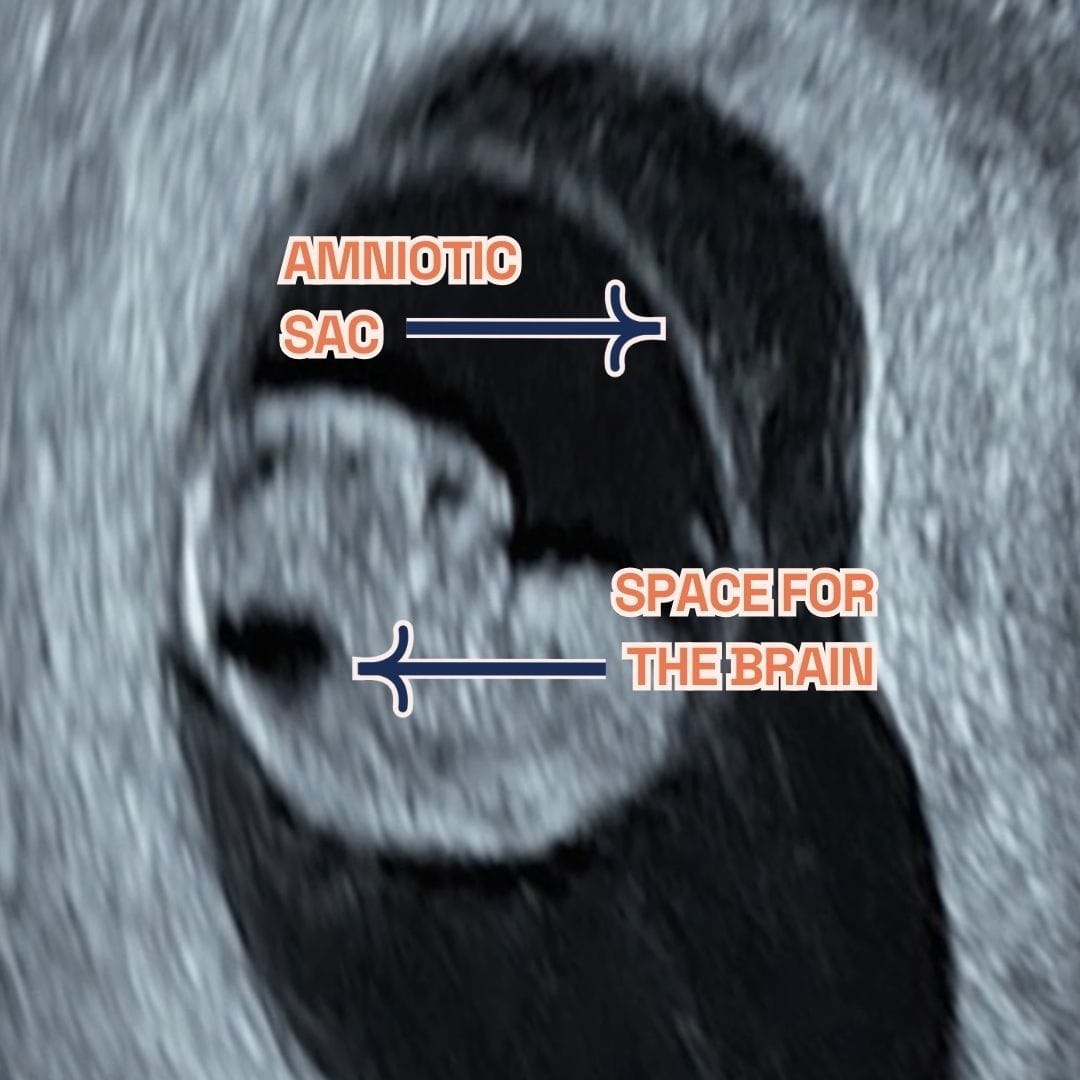
Gestational sac, fetal pole and amniotic sac at 8 weeks of pregnancy as seen on ultrasound scan.
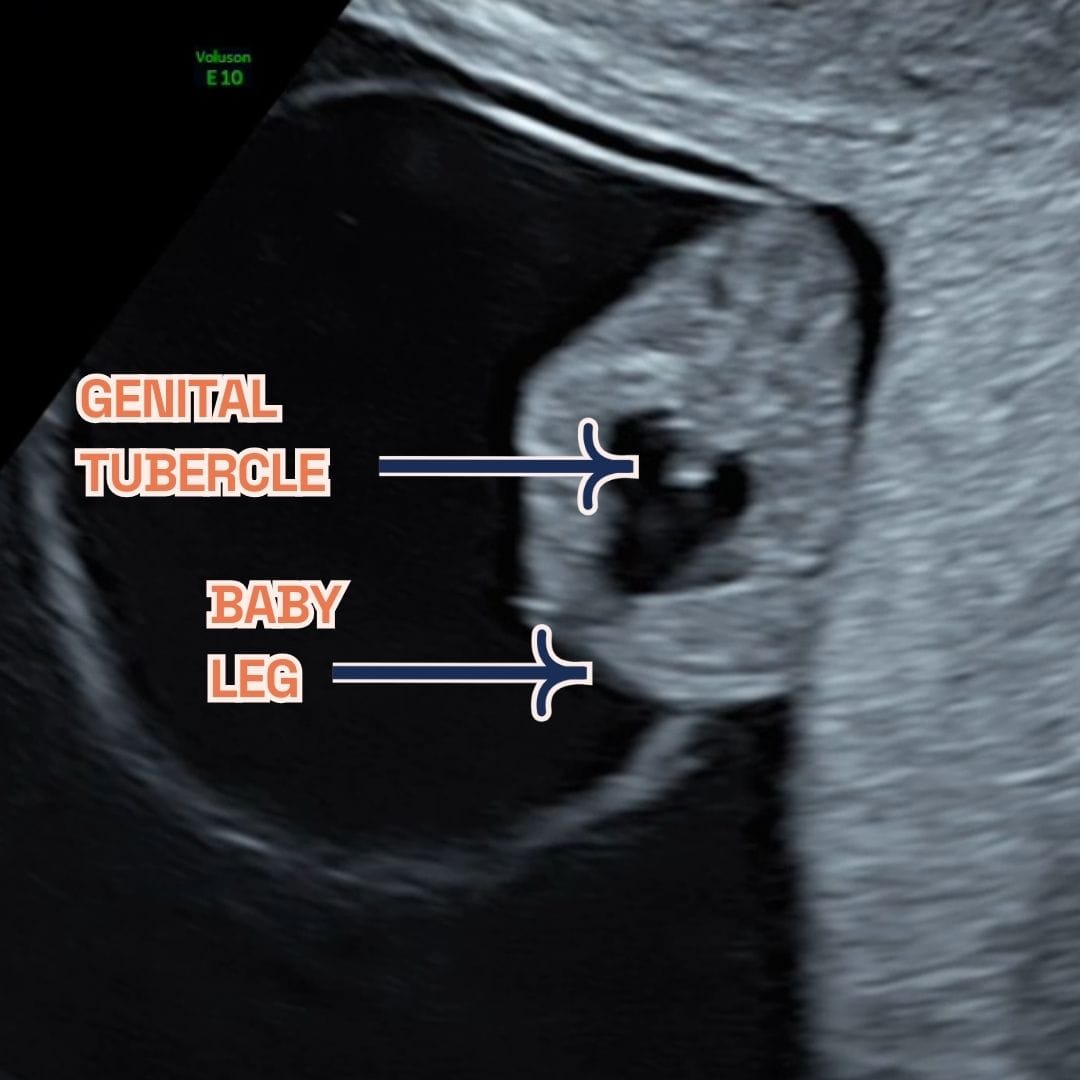
Gestational sac, fetal legs and Genital Tubercle at 9 weeks of pregnancy as seen on ultrasound scan.
Scans and Tests Available at 10 Weeks
Week 10 opens up several options for checking on your baby’s health. Which ones you choose is a personal decision, and it can help to talk them through with your midwife, doctor or one of our specialists.
Non-Invasive Prenatal Testing (NIPT): NIPT is a screening test that analyses small fragments of your baby’s DNA (which come mainly from the placenta) circulating in your blood. Most NIPTs can be taken from 10 weeks of pregnancy. Panorama NIPT can be taken from 9 weeks. It screens for chromosomal conditions such as Down’s, Edwards’ and Patau’s syndromes and can also report the baby’s sex. Because it only needs a blood sample from you, it does not carry the small risk of miscarriage linked to invasive tests. You can read more on our NIPT page.
The 10 Week Scan: You may be considering our 10 Week Scan. It is different from the usual viability or dating scans you might be familiar with. Designed for 10 to 11 weeks of pregnancy, it is the earliest anomaly scan we offer: a first structural examination of your baby, looking for a number of major physical conditions that can already be seen at this stage. It is also a convenient time to have NIPT, because both can be done at the same appointment. It does not replace the NHS 12-week scan or the 20-week anomaly scan, as some conditions only become visible later in pregnancy.
NHS dating scan and combined test: The NHS offers a dating scan at around 10 to 14 weeks of pregnancy (often called the 12-week scan). It confirms your due date, checks how many babies there are and looks at your baby’s development.
The NHS combined screening test for Down’s, Edwards’ and Patau’s syndromes uses a blood test together with a measurement of the fluid at the back of your baby’s neck (nuchal translucency). The nuchal measurement can only be taken once your baby’s crown–rump length is between 45 mm and 84 mm, which usually means from about 11 weeks and 2 days. At 10 weeks, your baby is still a little too small for this part of the test.
Diagnostic tests: NIPT and the combined test are screening tests. They tell you how likely it is that your baby has a condition, but they cannot confirm it. A higher-chance result needs a diagnostic test to confirm it. The options are chorionic villus sampling (CVS), usually carried out between 11 and 14 weeks, or amniocentesis, usually between 15 and 20 weeks. These tests give a definite answer but carry a small risk of miscarriage, so they are normally offered after a higher-chance screening result or where there is a known family history.
Always check whether your insurance covers NIPT. The chance of a baby having a chromosomal condition such as Down’s syndrome rises with maternal age, which is one reason many parents over 35, or with a family history of genetic conditions, choose to have early screening.
Thinking ahead: Week 11?
Over the next week your baby will keep growing quickly, and during week 11 will grow from around 4 cm to about 5 cm from crown to rump. If you have booked NHS screening, your dating scan and combined test will usually take place over the next few weeks. Keep your antenatal appointments and share any concerns with your midwife or doctor.
Week 10: Your body?
Your body is working hard to support the pregnancy, and many women find the first trimester the most tiring stage. Pregnancy hormones can cause headaches, dizziness, constipation, indigestion and bloating, partly because the muscles in your digestive tract become looser. Your blood volume is increasing, and your growing womb presses on your bladder, so you may need to pass urine more often.
Keep hydrated by drinking plenty of water, aiming to drink more earlier in the day to avoid night-time trips to the loo. You may notice your waist starting to thicken and your clothes feeling tighter as your womb grows, although most women don’t have an obvious bump yet. Most women gain between 10 kg and 12.5 kg (22 lb to 28 lb) over the whole pregnancy, and most of that weight is put on after week 20. You don’t need to “eat for two”, even if you are hungrier than usual.
Morning sickness and food aversions may mean you lose a little weight rather than gain it at this stage. For most women, pregnancy sickness clears up by weeks 16 to 20. Discuss any weight concerns, gain or loss, especially if changes are sudden or severe, with your obstetrician or midwife. Many people under-report nausea and vomiting, but there are treatments that are suitable in pregnancy, so it is worth asking for help rather than struggling on.
When to Seek Help
Most of the symptoms of early pregnancy are normal, but some need prompt advice. Call your maternity unit or early pregnancy unit (or NHS 111 if you don’t have a maternity unit yet) if you have light bleeding or spotting, or mild tummy pain.
Call 999 or go to A&E if you have heavy bleeding (soaking a pad soon after putting it on), severe pain in your tummy, pain in your shoulder, or you feel faint, dizzy or lose consciousness.
With pregnancy sickness, contact your midwife, GP or NHS 111 if you cannot keep food or fluids down for 24 hours, have very dark urine or haven’t passed urine for more than 8 hours, feel very weak, dizzy or faint when standing, have tummy pain or a high temperature, vomit blood, or are losing weight. These can be signs of dehydration or hyperemesis gravidarum, a severe form of pregnancy sickness that needs treatment.
Also speak to your midwife or GP if you are struggling with your mood or anxiety. Your mental health matters just as much as your physical health in pregnancy. If you would like an early check of your baby after a bleed, our early pregnancy bleeding scan can offer reassurance, but it should not replace urgent NHS care when you need it.
Week 10 of Pregnancy FAQs
What happens during week 10 of pregnancy?
At 10 weeks pregnant, your baby moves from the embryonic stage to the fetal stage. All the essential organs have formed, the fingers and toes have separated, the face is becoming more defined, and your baby is growing by nearly a centimetre a week. You may still be feeling tired and sick, and you might notice your clothes getting a little tighter around the waist.
An early scan at this stage shows your baby’s head, body and limbs clearly, the heartbeat, and often small movements. It is also the earliest point for most NIPTs and for our 10 Week Scan.
How big is my baby at 10 weeks?
During week 10, most babies measure roughly 32 to 41 mm from crown to rump, about the size of a small apricot. A scan measurement slightly outside this range is common and is not usually a cause for concern. Your sonographer or doctor will interpret it alongside the date of your last period.
Is spotting at 10 weeks of pregnancy normal?
Light bleeding or spotting is fairly common in the first trimester and does not always mean something is wrong. However, it should always be checked. Contact your maternity unit, early pregnancy unit or GP for advice, or NHS 111 if you don’t have a maternity unit yet.
Get urgent help by calling 999 if the bleeding is heavy or you have severe tummy pain, shoulder pain, or feel faint or dizzy. Every pregnancy is different, and your healthcare provider can give you advice tailored to your situation.
Can I do NIPT at 10 weeks of pregnancy?
Yes. Most NIPTs can be taken from 10 weeks of pregnancy, and Panorama can be taken from 9 weeks. NIPT analyses fragments of DNA in your blood to screen for chromosomal conditions such as Down’s, Edwards’ and Patau’s syndromes. Many parents choose to have NIPT at the same visit as our 10-week scan, so the scan can confirm the dating, the number of babies and early development before the blood sample is taken.
NIPT has high detection rates for Down’s syndrome, although detection is lower for some other conditions and results are reported as a chance, not a diagnosis. Discussing NIPT with your healthcare provider can help you decide whether it suits your needs and understand what the results could mean.
Benefits of NIPT include:
- Only a blood sample from you is needed, so it does not carry the risk of miscarriage linked to CVS or amniocentesis.
- High detection rates for the most common chromosomal conditions.
- Results early in pregnancy, giving you time to consider your options.
- Optional sex determination.
Remember: NIPT is a screening test, not a definitive diagnosis, and a higher-chance result needs to be confirmed with a diagnostic test. Consult your healthcare provider for further information and personalised guidance. We at LPC offer multiple NIPTs (PrenatalSafe, Panorama, Unity, SMART TEST, TDL VeriSeq V2, Harmony) and our specialists will help you choose the best option for you!
Can you tell the baby’s sex at 10 weeks?
Not reliably by ultrasound. The external genitals are only just beginning to form and look very similar in boys and girls at this stage. Many NIPTs, however, can report the baby’s sex from a blood test taken from 10 weeks.
Can I feel my baby move at 10 weeks?
No, not yet. Although your baby is making small movements that can be seen on a scan, they are far too small to feel. Most people start to feel their baby move between 16 and 24 weeks, and if this is your first baby it may be after 20 weeks.
Common symptoms during ten weeks pregnant
At 10 weeks you may notice:
- Fatigue: Extreme tiredness is very common in the first trimester. Make rest a priority.
- Frequent urination: Your growing womb presses on the bladder, meaning more trips to the loo.
- Morning sickness: Nausea and vomiting can happen at any time of day. Keep hydrated and try small, frequent meals.
- Changed sense of taste and smell: You may notice a metallic taste or be put off by strong smells.
- Mood swings: Hormonal changes may affect your emotions. Treat yourself gently.
- Sore breasts: Hormones are preparing your breasts for feeding, which can cause tenderness.
- Bloating, indigestion and constipation: Pregnancy hormones slow down digestion.
- Headaches and dizziness: These are common in early pregnancy. Get advice if they are severe or don’t go away.
- Light spotting: This can happen, but always contact your midwife or doctor if you notice bleeding.
- Other signs: A thin, white, milky discharge is normal during pregnancy.
Each pregnancy differs. Some women get many symptoms; others have few. Always consult your healthcare provider with concerns. Consider a private midwife consultation for worries.
Final Thoughts
Week 10 is a real milestone: your baby is now a fetus, with all the main body structures in place and a heartbeat that is easy to see on a scan. London Pregnancy Clinic is here to guide and support you through every step. With each visit, you’ll gain deeper insights into your baby’s development, reinforcing the bond you share. Embrace this journey with confidence, knowing we’re by your side.
Stay informed and excited about what each new week will reveal about your baby’s growth on our blog.