Blighted Ovum (Empty Pregnancy Sac): Why Did It Happen?

Also called anembryonic pregnancy

Empty gestational sac

A blighted ovum, or anembryonic pregnancy, is when a pregnancy sac grows in the womb with no embryo developing inside. It often follows a chance chromosome change and is not caused by anything you did. Here we explain how it is confirmed, why it happens and when testing may help.

One scan showing an empty sac is not always the final word, and NICE sets out when a repeat scan or second opinion is needed first. If you are thinking about genetic testing, some options are only possible while the pregnancy is still in the womb, so it is worth asking early.

The basics

What is a blighted ovum?

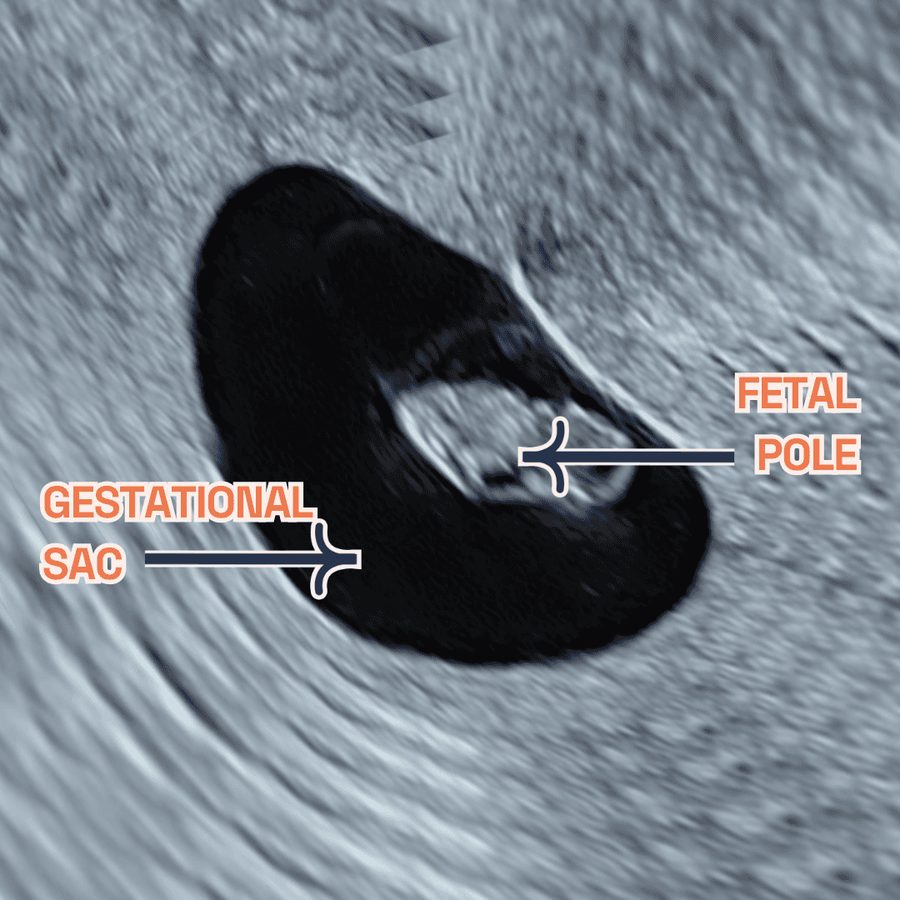
After a fertilised egg implants in the womb, two things normally develop together: the pregnancy sac with its early placenta, and the embryo inside it. With a blighted ovum, the sac and placental tissue form and keep growing, but the cells that should become the embryo stop developing very early and are reabsorbed by the body. A scan then shows a sac with no embryo in it, sometimes reported as 'no fetal pole'.

Many clinicians now prefer the term anembryonic pregnancy, meaning 'without an embryo', and many people find 'blighted ovum' upsetting. It is still widely used in hospitals, though, so you may see either name in your notes, or hear it called an empty sac or empty gestational sac. All of them describe the same type of early miscarriage, and it is a common one.

Because the placental tissue keeps working for a while, pregnancy hormone levels can stay high. Home tests stay positive, and a missed period, sore breasts and sickness can all carry on as normal. That is why many people have no idea anything is wrong, and why the diagnosis at a scan can come as such a shock.

Researchers think development stops by around the fifth week of pregnancy, yet the sac can keep growing for weeks and look like a developing pregnancy. Most anembryonic pregnancies are diagnosed between 8 and 13 weeks, often at a first or routine early scan, so there can be a long gap between the pregnancy stopping and anyone knowing.

Early pregnancy ultrasound with the gestational sac and the fetal pole labelled
A developing pregnancy shows a fetal pole inside the sac; with an anembryonic pregnancy, none is seen

Telling them apart

Empty sac, missed miscarriage or simply too early?

Three early scan findings are easily confused. Only the clinician who has seen your images can say which one applies to you.

No embryo seen

Anembryonic pregnancy (blighted ovum)

The sac has grown, but no embryo is visible inside it. The embryo never formed or stopped extremely early, leaving only the supporting structures of the pregnancy. It is counted as a type of missed miscarriage, and because the sac keeps growing the loss can go unrecognised for weeks.

No heartbeat

Missed miscarriage with an embryo

An embryo developed far enough to be measured, then stopped, so the scan shows an embryo with no heartbeat. Read more about missed miscarriage.

Repeat scan

A pregnancy that is too early to judge

The sac is still small, under 25 mm on an internal scan, and nothing is visible inside it yet. This may be a healthy pregnancy that is younger than the dates suggest, which is why NICE advises a repeat scan at least 7 days later before any diagnosis.

Diagnosis

How an empty sac is confirmed

In the UK, NICE guidance sets out how an anembryonic pregnancy should be diagnosed. An internal (transvaginal) scan is offered first because it gives the clearest view. If no embryo can be seen, the sonographer measures the mean gestational sac diameter, which is the average size of the sac.

The rules are deliberately cautious. A single scan cannot be guaranteed to be 100% accurate, and mistakes are most likely very early in pregnancy, so the guidance builds in time and a second check.

What the scan showsType of scanWhat NICE recommends before a diagnosis
Sac under 25 mm, no embryo visibleInternal (transvaginal)A second scan at least 7 days later; further scans may be needed
Sac 25 mm or more, no embryo visibleInternal (transvaginal)A second opinion on the scan, a repeat scan at least 7 days later, or both
No embryo visible, any sac sizeAbdominal scan onlyRecord the sac measurement, then repeat the scan at least 14 days later

NICE also says the date of your last period may not show accurately how far along you are, because cycles vary, so it should not be used on its own to decide whether a heartbeat ought to be visible. Waiting for a repeat scan does not harm the pregnancy.

Blood hCG tests are not part of NICE's criteria for diagnosing a miscarriage in the womb. NICE uses them mainly when the location of a pregnancy is not yet known.

Waiting

Why waiting for a second scan matters

Being asked to come back in a week or two is hard, but the wait has a purpose. You may have ovulated later than your dates suggest, particularly if your cycles are irregular, so the pregnancy may simply be younger than expected. Very early pregnancies may not show an embryo yet even when all is well, and a repeat scan gives one time to appear.

If the second scan still shows no embryo where one would clearly be expected, the diagnosis can usually be made with confidence. While you wait, contact your early pregnancy unit if you have heavy bleeding or pain. NICE says you should be given a 24-hour number to speak to someone experienced in early pregnancy problems.

Telling a very early, healthy pregnancy apart from an anembryonic one can be subtle and relies on experience in early pregnancy scanning and good equipment. An accurate, timely answer lets you make informed decisions and begin to come to terms with what has happened, while a wrong or delayed one adds to the distress. If you would like an independent specialist view, a second-opinion scan is available alongside your NHS care.

What chromosome studies of empty sacs have found

These figures describe groups of pregnancies, mostly analysed with traditional chromosome tests, and cannot tell you the cause of any one loss. The studies are listed at the foot of this page.

58% Anembryonic pregnancies with an abnormal chromosome result in a US fertility-clinic study of 272 miscarriages, compared with 68% when a fetal pole was visible (Lathi et al., 2007)
57% Abnormal results among 266 anembryonic pregnancies in a Russian series of 1,551 miscarriages, compared with 53% when a fetal pole was visible (Nikitina et al., 2023)
16 to 40% Estimated share of first-trimester miscarriages that are anembryonic; figures vary between studies (summarised by Nikitina et al., 2023)
About 1 in 2 Sporadic miscarriages caused by a chromosome change in the pregnancy, according to the Royal College of Obstetricians and Gynaecologists

Causes

Why does a blighted ovum happen?

In most cases the cause is thought to lie in the pregnancy itself. An embryo needs the right number of chromosomes, the packages that carry our genetic instructions, to develop. When a chromosome is extra or missing, or there is a whole extra set, development can stop before an embryo is ever visible. In two studies of anembryonic pregnancies, close to 6 in 10 of those tested had a chromosome change, a similar share to miscarriages where an embryo was seen.

These changes usually happen by chance, as the egg or sperm forms or in the first cell divisions after fertilisation. They are not usually inherited, and the parents' own chromosomes are normally healthy. The problem was present from the very start, which meant the pregnancy could not develop. It is not caused by anything you did or did not do, and it could not have been prevented.

An extra copy of one chromosome (a trisomy) is the most common finding. In the large Russian series, trisomies were found in about 28 in 100 anembryonic pregnancies. A doubled set of chromosomes (tetraploidy) was more common than in losses with an embryo, including when rechecked on uncultured tissue, while triploidy (a single extra set) and changes in the number of sex chromosomes, such as a missing X, were less common.

Age plays a part. As women get older, the number and quality of their eggs decline, and chromosome errors become more common. The NHS lists being 35 or over among the things that raise the chance of miscarriage. Even so, a blighted ovum can happen at any age, and most cases are random events.

When testing shows normal chromosomes, the cause may still be genetic at a level standard tests cannot see, such as very small chromosome changes or a change in a single gene. After repeated losses, doctors also look for causes in the mother; our recurrent miscarriage page explains those investigations.

Genetic testing

Can genetic testing explain an empty sac?

Testing is a personal choice, and it cannot always find a cause. With an anembryonic pregnancy there is no embryo to test, but the placental tissue grows from the same fertilised egg, so its chromosomes can be checked instead. Which route is open to you depends on where you are now; this guide to what you can test now sets out the options.

01

Before the sac has passed

The placenta releases tiny fragments of its DNA into your bloodstream. A blood-based test (a cell-free DNA test, which works on the same principle as NIPT) counts these fragments to look for extra or missing chromosomes. Because the DNA comes mainly from placental cells, the test can still be done when no embryo has formed: a small Bristol study found normal levels of this DNA in pregnancies with an empty sac.

Timing matters. Placental DNA in the blood is highest while the tissue is still in the womb and falls once it has passed or been removed. In a large Danish study, about 1 in 11 samples taken with the tissue in place gave no result, rising to more than 1 in 4 when taken 12 to 24 hours after it had passed. A scan shortly before the sample confirms the sac is still there.

This is a screening test, not a final answer. Across studies it picked up about 78 in 100 of the chromosome changes found in tissue, and about 1 in 10 pregnancies with normal tissue results were wrongly flagged. Most methods cannot detect extra whole sets of chromosomes, which occur in some empty-sac pregnancies.

Blood-based testing after a miscarriage is not part of routine NHS care. If you would like to explore it, our genetic counsellors can talk through whether it suits your situation and what is currently available.

02

Testing tissue from the sac

Once the pregnancy has passed or been removed, the tissue itself can be tested. An empty sac may contain little or no embryonic tissue, but the placental tissue (chorionic villi) is what laboratories normally analyse, and studies of anembryonic pregnancies show it can give useful chromosome results.

Many laboratories now use a chromosomal microarray, which reads DNA directly and does not need cells to grow. Traditional karyotyping relies on growing living cells and fails in about 1 in 5 samples. Sometimes the mother's cells are tested by mistake, which can make the result look like a normal female pregnancy; a SNP-based array or a sample of the mother's blood can check for this.

The tissue should reach the genetics laboratory fresh and quickly. Tissue placed in formalin, the preservative used for routine pathology, is usually unsuitable, so tell your team before treatment that you would like genetic testing. Our page on pregnancy tissue testing explains the process.

03

What the NHS offers

On the NHS, chromosome testing of pregnancy tissue is usually offered from the third miscarriage onwards and after any miscarriage from 14 weeks, or sooner if there are features suggesting a chromosome condition. After a first anembryonic pregnancy it is not routinely offered, although you can ask your early pregnancy unit. Private testing is possible after a single loss, and our genetic testing and counselling team can explain the options first.

04

If the tissue was not tested

If no tissue was tested, the cause of this loss cannot be confirmed afterwards. Testing the parents' chromosomes is not routine after one miscarriage. UK guidance reserves it for couples whose pregnancy tissue showed an unbalanced rearrangement, or who have had recurrent miscarriages where tissue could not be tested; see parental chromosome testing.

Treatment

Choosing how to manage an anembryonic pregnancy

Once the diagnosis is certain, there are three ways to complete the miscarriage. Unless you need urgent treatment, you should usually be able to choose, and your team will explain which options suit your circumstances. Each one affects whether and how genetic testing can be done, so it helps to think about testing first.

Expectant

Waiting for it to happen naturally

NICE recommends waiting for 7 to 14 days as the first option for most people. It avoids medicines and procedures and can feel more natural, but it may take several weeks and needs monitoring, and some people find the uncertainty hard. While you wait, the sac is still in the womb, so a blood-based test may still be possible.

Medical

Tablets to help the pregnancy pass

For a missed miscarriage, which includes an empty sac, NICE recommends 200 mg of mifepristone by mouth, then 800 micrograms of misoprostol 48 hours later. You can expect cramping and bleeding, as with a natural miscarriage; contact your unit if bleeding has not started within 48 hours of the misoprostol. It is often quicker than waiting and gives you more control over timing. A home pregnancy test 3 weeks later checks it is complete.

Surgical

A short procedure using suction

The tissue is removed through the cervix with gentle suction, either awake with local anaesthetic in a clinic (manual vacuum aspiration) or asleep under general anaesthetic in theatre. It usually takes 10 to 15 minutes, you can normally go home the same day, and it is sometimes still called a D&C. It suits people who want a quick resolution, have a higher risk of heavy bleeding or infection, or whose other treatment has not worked, and tissue can be collected for testing.

If you choose to wait: what one London study found

From a study at St George's Hospital early pregnancy unit of 92 women who chose to wait after an anembryonic pregnancy was diagnosed (Luise et al., 2002). Times are counted from diagnosis, not from when the pregnancy stopped, and at the time surgery was the only alternative offered.

1 in 4 Had passed the pregnancy naturally within 7 days
About half Had completed the miscarriage within 14 days
2 in 3 Had completed it without surgery by about 6 weeks; the rest had surgery

Coping

When the first scan brings this news

For many couples the first scan is one of the most anticipated moments of pregnancy, so learning that the sac is empty can be devastating. You may already have pictured the future or shared your news. Because symptoms often carry on as normal, the diagnosis can feel unreal, and it is natural to wonder whether the scan could be wrong.

Some people worry that they have less right to grieve because the scan never showed an embryo. There is no right way to feel: you were pregnant, and the loss is real. Many also wonder whether they caused it, and feel guilty. A blighted ovum is a chance event, not the result of anything you did.

Support is available from your GP or early pregnancy unit, and from Miscarriage UK (0303 003 6464) and Tommy's (0800 0147 800). In England you can also request a baby loss certificate to recognise your loss. Our miscarriage care page describes the support we offer in London.

Cupped hands gently holding a single pale flower
Grief after an early loss is real, however early the pregnancy stopped

Looking ahead

Will it happen again?

Another anembryonic pregnancy can happen, but it is unlikely. A single anembryonic pregnancy is a chance event and does not, on its own, point to a fertility problem. Most people who have one go on to have a healthy pregnancy, and the NHS notes that most women who have had a miscarriage go on to have a successful pregnancy in the future.

If testing did find a chromosome change, the outlook for the next pregnancy is generally better than when a lost pregnancy had normal chromosomes, although age still matters, and this may not apply if a parent is found to carry a chromosome rearrangement.

The NHS advises that you can try for another pregnancy when you feel ready, once your symptoms have gone. Your first period can take up to 8 weeks to return. Some couples choose to wait for it before trying, but that is a personal choice. Taking folic acid before you conceive is recommended for every pregnancy.

If you have had three or more miscarriages, talk to your GP, who will usually refer you for tests. In a new pregnancy an early scan can bring reassurance; our viability scan checks the pregnancy is in the womb and looks for a heartbeat from 6 weeks.

Alongside your NHS care

Specialist support from our London team

Your NHS early pregnancy unit remains the right place for repeat scans, treatment and urgent care, all free of charge. If you would like extra support alongside it, our team can help at our City of London and West London clinics or online.

Your questions about a blighted ovum

Is a blighted ovum the same as an anembryonic pregnancy or an empty sac?

Yes. All three describe a pregnancy sac that has developed without an embryo inside it. Many clinicians now prefer 'anembryonic pregnancy', but 'blighted ovum' still appears in hospital notes and scan reports.

Was there ever an embryo?

Sometimes, very briefly. In some cases the cells that would have formed the embryo start to develop, then stop at a very early stage and are reabsorbed before they can be seen on a scan; in others an embryo does not form at all. Either way, the sac and placental tissue carry on growing, which is why the sac looks empty.

My sac measured under 25 mm with nothing inside. Is the diagnosis certain?

Not yet. Under NICE guidance, a sac under 25 mm on an internal scan with no visible embryo needs a repeat scan at least 7 days later before a miscarriage can be diagnosed, because the pregnancy may simply be younger than your dates suggest. Waiting does not harm the pregnancy.

Can hCG blood tests confirm a blighted ovum?

Not on their own. In the UK, a miscarriage in the womb is diagnosed from the scan measurements set out by NICE. Because the placental tissue can keep making pregnancy hormone for a while after development stops, an hCG result on its own cannot confirm or rule out an anembryonic pregnancy.

If there was no embryo, what does a genetic test actually look at?

The placental tissue, which grows from the same fertilised egg. Laboratories test this tissue after a miscarriage, and blood-based tests read DNA released by the placenta, so neither needs an embryo to have formed. See testing before a miscarriage completes for the time-sensitive option.

Do I need a D&C for a blighted ovum?

No. Surgery is one of three options, alongside waiting and taking tablets. The procedure now uses gentle suction and can be done under local or general anaesthetic. The right choice depends on your preferences, your health and whether there is a higher risk of heavy bleeding or infection.

Will a blighted ovum make it harder to get pregnant again?

Usually not. Most people go on to have a healthy pregnancy after an anembryonic pregnancy. If you have had three or more miscarriages, ask your GP about investigations; our recurrent miscarriage page explains what is usually checked.

About this information

This guide describes an anembryonic pregnancy in general terms. It cannot replace advice from the clinicians who know your history and have seen your scans. If you have heavy bleeding, severe pain or a high temperature, or you feel faint, contact your early pregnancy unit or call NHS 111, and call 999 in an emergency.

Contact

Questions about an empty sac?

Send us an enquiry

This form is not for emergencies. If you are bleeding heavily, in severe pain or feel faint, call 999 or go to A&E.

For urgent matters please call 020 3687 2939.

Sources & clinical references

The figures and clinical statements on this page are drawn from the sources below. Guidance evolves — always discuss your individual circumstances with a clinician.

  1. NICEEctopic pregnancy and miscarriage: diagnosis and initial management (NG126), recommendations 1.6 (diagnosis) and 1.10 to 1.12 (management)2026
  2. NHSMiscarriage2026
  3. Miscarriage UKAnembryonic pregnancy ('blighted ovum')Accessed October 2026
  4. Tommy'sSurgical management of miscarriageAccessed October 2026
  5. BMJ (Luise et al.)Outcome of expectant management of spontaneous first trimester miscarriage: observational study2002
  6. Journal of Assisted Reproduction and Genetics (Lathi et al.)Cytogenetic testing of anembryonic pregnancies compared to embryonic missed abortions2007
  7. Vavilov Journal of Genetics and Breeding (Nikitina et al.)Comparative cytogenetics of anembryonic pregnancies and missed abortions in human2023
  8. RCOGRecurrent Miscarriage (Green-top Guideline No. 17)2023
  9. Prenatal Diagnosis (Pauta et al.)Genome-wide cell-free DNA analysis for aneuploidy detection in miscarriages: test performance meta-analysis2025
  10. Prenatal Diagnosis (Alberry et al.)Free fetal DNA in maternal plasma in anembryonic pregnancies: confirmation that the origin is the trophoblast2007
  11. Human Reproduction (El Sammaa-Aru et al.)How big is the time window for cell-free fetal DNA testing after pregnancy loss and which factors are associated with a successful result?2026
  12. North West Genomic Laboratory Hub (Manchester University NHS Foundation Trust)Acceptance criteria and requirements for solid tissue samples following loss of pregnancy2025