
No Heartbeat on Your Pregnancy Scan: What Happens Next?

Hearing that the scan shows no heartbeat is a shock, especially at a routine appointment when nothing seemed wrong. It does not always mean a miscarriage on the day: early on, a pregnancy can be younger than your dates suggest, and NICE sets size-based checks before any diagnosis is made.

Below, our team explains what it can mean from 7 to 12 weeks, when a repeat scan is needed, the most common cause, and which genetic tests may still be possible if a missed miscarriage is confirmed.

Available atLPC City (E1)

In brief

The most important things to know first

  • Early on, a pregnancy can be younger than your dates suggest, so a heartbeat may simply not be visible yet.
  • One scan cannot always give a certain answer, which is why NICE sets checks before a miscarriage is confirmed.
  • If a miscarriage is confirmed, a chance chromosome change is the most common cause, not anything you did.
  • Some genetic tests are time-sensitive, so ask about testing before any tablets or surgery.
  • If you have heavy bleeding, severe pain or feel faint, call 999 or go to A&E rather than waiting for a scan.

Understanding the finding

What 'no heartbeat' on a scan can mean

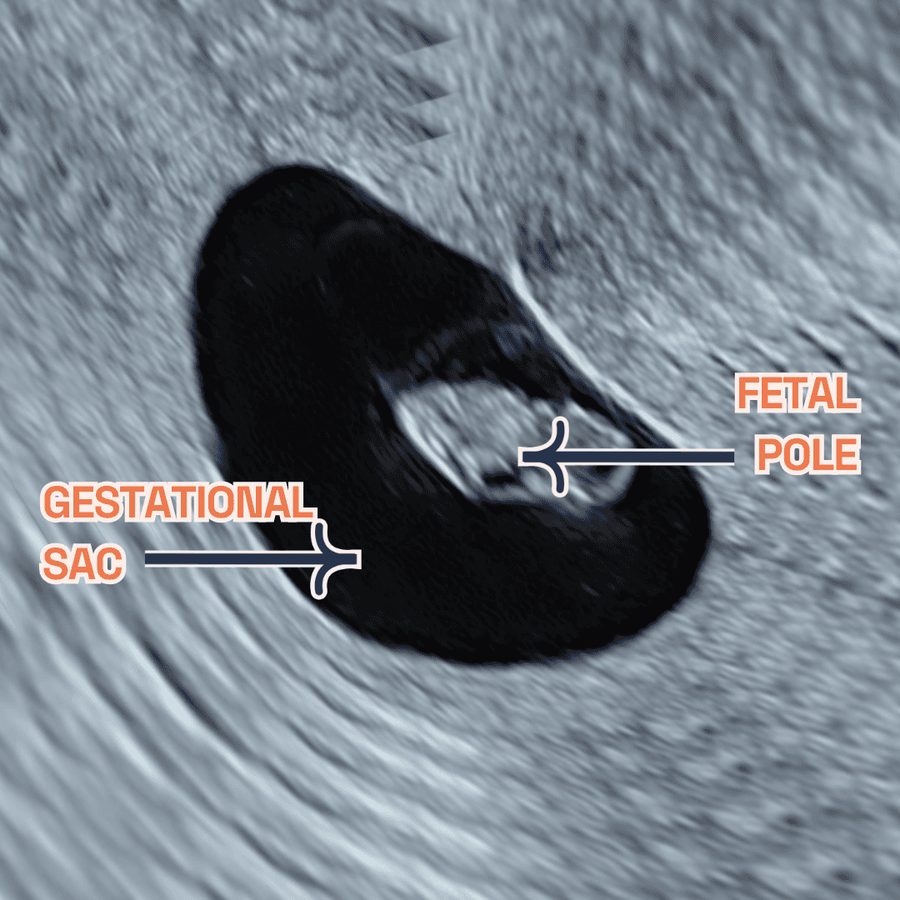
The person scanning you looks first for a heartbeat. If there is none, they measure what is there: the embryo from head to bottom (the crown–rump length, or CRL) or, if no embryo is visible, the average width of the pregnancy sac. These measurements, not your period dates, decide what happens next.

There are three broad possibilities. The pregnancy may be too early for a heartbeat to show. It may have stopped developing but not yet come away, called a missed or silent miscarriage. Or the sac may have grown without an embryo inside, known as an anembryonic pregnancy or blighted ovum.

If no pregnancy can be seen in the womb at all (a pregnancy of unknown location), you will be followed up, usually with blood tests for the pregnancy hormone hCG and sometimes more scans, until it is clear where the pregnancy is or that it has ended, because an ectopic pregnancy cannot be ruled out until then. A heartbeat that is present but slow is a different finding, covered in baby's heart rate by week.

Ultrasound scan of an early pregnancy, labelled to show the gestational sac and fetal pole
The sac and the fetal pole are what is measured when no heartbeat is seen

By stage of pregnancy

What no heartbeat can mean at 7, 8, 9, 10 and 12 weeks

Weeks here are counted from the first day of your last period. Treat them as a rough guide: what matters is what the scan measures, and our CRL calculator shows how a measurement relates to weeks of pregnancy.

01

No heartbeat at 6 or 7 weeks

Not seeing a heartbeat now can simply be a question of timing. NICE notes that a single scan is least certain very early on, and that period dates may not reflect how far along you are, because cycles vary. On an internal scan, if the embryo is under 7 mm, or the sac is under 25 mm with no embryo, a repeat scan at least 7 days later is always needed. Your notes may call this a pregnancy of uncertain viability.

02

No heartbeat at 8 weeks

If the embryo measures 7 mm or more with no heartbeat on an internal scan, NICE advises a second opinion, a repeat scan at least 7 days later, or both. If it is under 7 mm, perhaps because it is smaller than your dates, a repeat scan is always needed: a pregnancy that is simply younger will usually have grown by then, while one that has stopped developing will not.

03

No heartbeat at 9 weeks

There is no routine NHS scan at 9 weeks, so a finding now often comes from a private early scan or one arranged because of bleeding or pain. The embryo usually looks smaller than expected for the dates, which can mean it stopped developing some time before. Once the NICE checks confirm it, the diagnosis is a missed miscarriage.

04

No heartbeat at 10 weeks

At this stage there is often no warning at all. Pregnancy hormones can stay high after a pregnancy stops developing, so you may still feel pregnant and a home pregnancy test can still read positive. Often there is no way you could have known without a scan. If it is found at a private scan, including our specialist 10-week scan, you can still be cared for by your NHS early pregnancy unit for repeat scans, treatment and support; your GP or midwife can usually refer you.

05

No heartbeat at the 12-week scan

In England the NHS offers its first routine scan, the dating scan, between about 10 and 14 weeks, so this is when many missed miscarriages are found. The measurements are often above the NICE size limits by now, so the diagnosis can be confirmed by a second specialist's opinion and/or a repeat scan at least 7 days later. If you would like more certainty before deciding anything, you can ask for a repeat scan.

When a miscarriage can be confirmed

The NICE checks before a miscarriage is diagnosed

NICE guideline NG126 sets these minimum steps for an internal (transvaginal) scan, which gives the clearest picture and is offered first. They are deliberately cautious, to avoid a developing pregnancy being wrongly diagnosed as a miscarriage.

What the scan showsWhat should happen before a diagnosis
Embryo under 7 mm, no heartbeatRepeat scan at least 7 days later; more scans may be needed
Embryo 7 mm or more, no heartbeatSecond opinion and/or repeat scan at least 7 days later
Sac under 25 mm, no embryo visibleRepeat scan at least 7 days later; more scans may be needed
Sac 25 mm or more, no embryo visibleSecond opinion and/or repeat scan at least 7 days later

With an abdominal scan only, the size is recorded and the repeat scan is at least 14 days later. NICE also says you should be told that a single scan is not 100% accurate, that waiting for a repeat scan does not harm the pregnancy, and you should be given a 24-hour phone number for advice.

Uncertain results

If you have been asked to come back for another scan

Waiting a week or more for an answer is hard, and many people describe feeling in limbo, swinging between hope and bracing themselves for bad news. The wait protects a pregnancy that may still be developing; it does not change the outcome. Contact your early pregnancy unit if bleeding or pain starts, and ask how to collect tissue if you would want it tested should the pregnancy pass at home.

Your NHS early pregnancy unit provides repeat scans free of charge. If you are around 10 weeks or more and results conflict or measurements are close to the limits, you may also want an independent specialist view: you can book a second-opinion scan (£360) with Dr Fred Ushakov.

If a missed miscarriage is confirmed

Your options, and what each means for testing

Without treatment, the pregnancy may come away within days or take several weeks, and you do not usually have to decide everything on the day of the scan. These are the options NICE sets out; your early pregnancy unit will support whichever you choose, and our miscarriage care page covers recovery.

OptionWhat it involvesWhat it means for genetic testing
Waiting (expectant management)The first-line option for 7 to 14 days, unless you have a higher risk of heavy bleeding, a previous traumatic pregnancy experience or an infectionAny blood-based test is best done before the pregnancy passes; ask how to collect tissue at home
Medicine (medical management)200 mg of mifepristone by mouth, then 800 micrograms of misoprostol 48 hours later, taken by mouth, under the tongue or vaginallyHave any blood-based test before the first dose; collecting tissue at home is not always possible
A procedure (surgical management)Manual vacuum aspiration under local anaesthetic in a clinic, or surgery under general anaestheticTissue can be sent for chromosome testing if this is arranged beforehand and it is kept fresh, not in preservative

Why it happens

Why a pregnancy stops developing

Often the heartbeat stops because of something within the pregnancy itself, and the most common recognised cause is a chromosome change that happened by chance. Sometimes no cause is found. These figures describe large groups, not any one pregnancy.

About 1 in 2 miscarriages happen because the pregnancy has a chromosome change (RCOG, 2023)
About 6 in 10 miscarriages that are tested show a chromosome abnormality (Lancet, 2021)
About 15 in 100 recognised pregnancies end in miscarriage, from pooled studies (Lancet, 2021)

The chromosome changes most often found

When a pregnancy starts with too many, too few or rearranged chromosomes, it often cannot develop normally. Most of these changes happen by chance as the egg or sperm forms, and the parents' own chromosomes are usually normal. See chromosomal causes of miscarriage for more.

Trisomy: one extra chromosome

The most common finding, about half or more of the changes seen in miscarriage. It usually arises as the egg forms and becomes more common as the egg gets older.

Triploidy: an extra set

69 chromosomes instead of 46, by chance. When the extra set comes from the father it can be a partial molar pregnancy, which needs follow-up hormone (hCG) tests.

Monosomy X: one sex chromosome

A single X chromosome instead of two sex chromosomes. One of the most common changes found after miscarriage, and usually a chance event.

Structural changes

A piece of chromosome is missing, extra or rearranged: around 6 in 100 of the changes found. Occasionally a parent carries a balanced form, which is when parental chromosome testing helps.

Genetic testing

Genetic testing once a miscarriage is confirmed

Testing cannot change what has happened and does not always find a cause, but for many people a result brings understanding, and it can guide care in a future pregnancy. Which test is possible depends mostly on whether the pregnancy is still in the womb; our guide to choosing a test walks through each situation.

Pregnancy still in the womb

Blood-based genetic testing

While pregnancy tissue is in place, the placenta releases fragments of its DNA into your blood for a test to analyse. It works best before any tablets or surgery, with a scan shortly beforehand. Results are screening-type, can miss some changes or give no result, and the test is not part of standard NHS care.

Pregnancy passed or removed

Pregnancy tissue testing

A genetics laboratory checks the tissue for chromosome changes. On the NHS this is usually offered from a third miscarriage or after any miscarriage from 14 weeks, and sometimes sooner, for example if a scan showed a physical abnormality. Tissue must be sent fresh, not in formalin.

Only in some situations

Testing the parents

A blood test of both partners' chromosomes (a karyotype) is not needed after most miscarriages. It is usually offered only when tissue shows an unbalanced rearrangement, or when tissue from recurrent miscarriages could not be tested.

Before treatment: questions worth asking

If genetic testing matters to you, asking early keeps your options open.

Can tissue from this pregnancy be tested on the NHS, and if not, can it be kept for private testing?

If I have a procedure, can the tissue be sent fresh rather than in formalin, the preservative used for routine pathology?

If the pregnancy passes at home, how should I collect and store tissue?

Can a blood-based test be done before I take any tablets or have surgery?

Alongside your NHS care

How our team can help

Your NHS early pregnancy unit remains the right place for repeat scans, treatment and urgent care. Alongside that, these services may help.

Looking after yourself

Support, whatever happens next

However early it happens, losing a pregnancy is a real loss, and there is no right way to feel. Miscarriage UK runs a support line on 0303 003 6464, and Tommy's midwives can be reached free on 0800 0147 800. In England you can also apply for a baby loss certificate to recognise your loss, whenever it happened.

No heartbeat on a scan: your questions

Can a scan be wrong when it shows no heartbeat?

It can. NICE advises that a miscarriage diagnosed on a single scan is not 100% certain, and the chance of error is highest very early on. That is why a smaller embryo or sac always needs a repeat scan at least 7 days later, and a larger one needs a second specialist's opinion and/or a repeat scan before a miscarriage is confirmed.

Could my dates just be wrong?

Yes, especially early on. NICE advises against using period dates alone to decide whether a heartbeat should be visible, because cycles vary. If you ovulated later than usual, the pregnancy may be younger than you think, and a repeat scan shows whether it has grown.

Did something I did make the heartbeat stop?

Usually not. The most common cause is a chance chromosome change. Exercise, sex, ordinary work, flying and everyday lifting do not seem to raise the risk, and there is no clear evidence that everyday stress causes miscarriage. Our guide Why did I miscarry? looks at the factors that are linked, and what that does and does not mean.

Will the NHS test why the pregnancy stopped developing?

Not usually after a first or second early miscarriage. UK guidance recommends offering tissue testing from the third miscarriage and after any miscarriage from 14 weeks; NHS laboratories may accept tissue sooner in some cases, such as when a scan showed a physical abnormality. Otherwise, our genetic counsellors can talk you through private pregnancy tissue testing.

If the cause was a chromosome change, will it happen again?

Most chromosome changes happen by chance and are not inherited, and most people who miscarry go on to have a healthy pregnancy. A miscarriage with a chromosome change is linked with a better outlook next time than one with normal chromosomes, although age still matters and this does not apply if a parent carries a chromosome rearrangement. See pregnancy after a chromosomal miscarriage for planning ahead.

Should I have a private scan to check the result?

Many people need nothing beyond their early pregnancy unit's free repeat scans. From around 10 weeks, a private second-opinion scan can help if results conflict or you would value an independent specialist view. Call us on 020 3687 2939 and we will advise.

About this information

This page describes a scan finding in general terms. It is not a substitute for advice from the doctors and sonographers who know your history and have seen your images. If you have heavy bleeding, severe pain or a fever, or feel faint, contact your early pregnancy unit or call NHS 111, and call 999 in an emergency.

Contact

Questions after a scan?

Send us an enquiry

Not for emergencies: if you are bleeding heavily, in severe pain or feel faint, call 999 or go to A&E.

For urgent matters please call 020 3687 2939.

Sources & clinical references

The figures and clinical statements on this page are drawn from the sources below. Guidance evolves — always discuss your individual circumstances with a clinician.

  1. NICEEctopic pregnancy and miscarriage (NG126): diagnosis of viable intrauterine pregnancy and of tubal ectopic pregnancy2026
  2. NICEEctopic pregnancy and miscarriage (NG126): management of miscarriage2026
  3. NHS12-week scan2023
  4. Miscarriage UKMissed miscarriageAccessed October 2026
  5. Miscarriage UKCauses and risk factors of miscarriageAccessed October 2026
  6. Royal College of Obstetricians and GynaecologistsRecurrent miscarriage (patient information leaflet)2023
  7. Royal College of Obstetricians and GynaecologistsRecurrent Miscarriage (Green-top Guideline No. 17)2023
  8. The Lancet (Quenby et al.)Miscarriage matters: the epidemiological, physical, psychological, and economic costs of early pregnancy loss2021
  9. North West Genomic Laboratory Hub (Manchester University NHS Foundation Trust)Acceptance criteria and requirements for solid tissue samples following loss of pregnancy2025
  10. Tommy'sUsing fetal DNA to detect chromosomal abnormalities following miscarriageAccessed October 2026
  11. Human Reproduction (El Sammaa-Aru et al.)How big is the time window for cell-free fetal DNA testing after pregnancy loss and which factors are associated with a successful result?2026
  12. BMJ Medicine (Joyce et al.)Advances in the diagnosis and early management of gestational trophoblastic disease2022